
Overview
Before investing a single rupee in website development, every business owner in India needs to understand one foundational concept — the difference between static and dynamic website types. This single decision determines your website development cost, your website maintenance requirements, your website performance, and how well the site serves your business over time.
The difference between static and dynamic website architecture is not just a technical detail for developers — it is a practical business decision with real consequences. The wrong choice means either overpaying for capability you don't need or under-building a foundation that cannot support your growth. Understanding the difference between static and dynamic website options clearly, before your website development begins, is the most cost-effective thing you can do.
This blog explains both types plainly, compares them directly, and gives you a clear framework for deciding which is right for your specific business.
What Is a Static Website?
A static website is one where every page is built in advance and stored as a fixed file on a server. When a visitor loads a page, the server delivers that pre-built file directly to the browser — no real-time processing, no server-side rendering, no database-driven website backend involved. The content every visitor sees on a static website is identical unless a developer manually edits the underlying code and redeploys the files.
A static website is built using HTML website files — pure HTML, CSS, and sometimes JavaScript. Every page on a static website exists as a separate HTML website file sitting on the server, ready to be delivered instantly. Because there is no server-side rendering, no PHP website backend, and no MySQL database to query, a static website delivers extremely fast page load speed and strong website performance scores by default.
Modern static website builds often use a static site generator — a development tool that compiles templates and content into finished HTML website files before the site goes live. A static site generator like Hugo, Jekyll, or Eleventy allows developers to manage a static website efficiently without hand-coding every page, while visitors still receive a pure HTML website with no backend processing overhead. This static site generator approach produces some of the best raw page load speed and website performance results available in website development today.
A static website is simpler to host, cheaper to maintain, and more secure than its counterpart — because there is no PHP website code executing on the server, no MySQL database exposed to attack, and no CMS requiring regular updates. Website maintenance for a static website is genuinely minimal.
What Is a Dynamic Website?
A dynamic website works entirely differently. Rather than serving pre-built files, a dynamic website generates page content in real time — each time a visitor makes a request, server-side rendering assembles the page by pulling data from a database-driven website backend and building the HTML on the fly before sending it to the browser.
The most common dynamic website architecture is a PHP website connected to a MySQL database. When a visitor loads a page on a PHP website, the PHP code queries the MySQL database, retrieves the relevant content — a blog post, a product listing, a user profile — and uses server-side rendering to construct the full page dynamically. Every page view on a PHP website triggers this server-side rendering process, which is why website performance optimisation matters more for a dynamic website than for a static website.
The most widely used dynamic website platform globally — and in India — is WordPress. A WordPress website is a CMS website (Content Management System) built on a PHP website foundation with a MySQL database backend. A WordPress website gives business owners a visual admin panel to publish content, manage pages, and update information without writing code. This CMS website model made dynamic website publishing accessible to non-technical users — and a WordPress website or similar CMS website now powers the majority of business sites in India.
Beyond the CMS website category, dynamic website technology powers every web application that requires user interaction — booking platforms, ecommerce stores, banking portals, and dashboards. Any web application where different users see different content, or where user actions change what is displayed, is built on dynamic website and server-side rendering principles. A web application is essentially a dynamic website taken to its fullest capability.
Static vs Dynamic Website: Key Differences
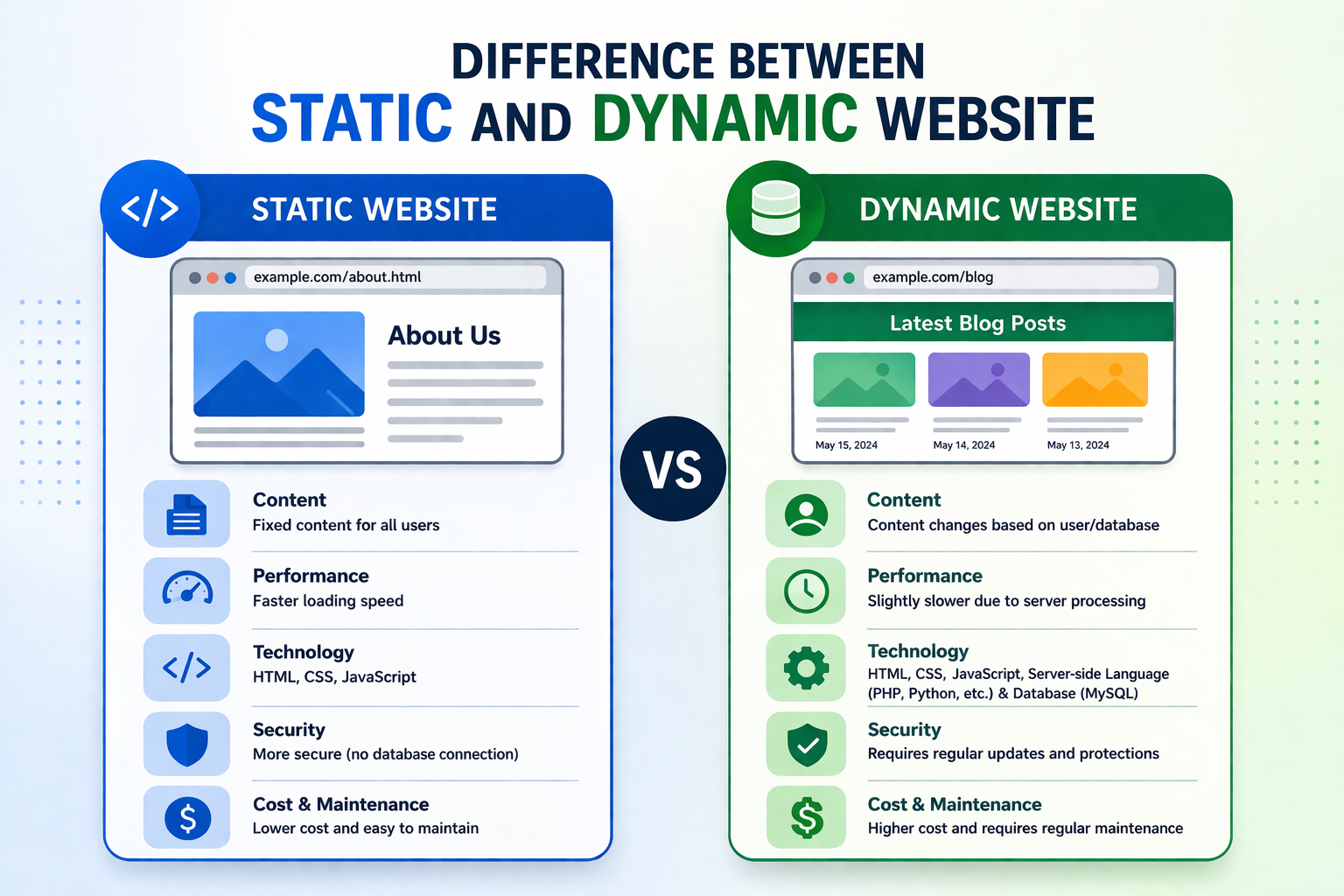
The static vs dynamic website comparison comes down to five areas that matter practically to every business owner making a website development decision.
Architecture and Page Generation
The core static website vs dynamic website difference is how pages reach the visitor. A static website serves pre-built HTML website files with no server-side rendering — the page is ready before the request arrives. A dynamic website uses server-side rendering to build pages from a database-driven website backend in real time. This static website vs dynamic website architectural difference is the source of every other distinction.
Page Load Speed and Website Performance
Page load speed is where the static website wins most clearly. Because there is no server-side rendering, no PHP website processing, and no MySQL database query on every visit, a static website delivers outstanding page load speed and website performance scores naturally. A dynamic website can achieve strong website performance and competitive page load speed with proper caching and optimisation — but it requires deliberate effort. Since Google uses page load speed as a ranking factor and visitors abandon slow pages in seconds, website performance should never be an afterthought in any website development project.
Website Development Cost and Website Maintenance
Website development cost is consistently lower for a static website — less backend development, no MySQL database setup, no server-side rendering logic, and simpler hosting all reduce website development cost significantly. Website maintenance is also lighter — no CMS website updates, no PHP website version management, no MySQL database backups to schedule. A dynamic website carries higher website development cost because of backend complexity, and ongoing website maintenance includes regular WordPress website core updates, plugin management, MySQL database maintenance, and security monitoring.
Content Management Flexibility
This is where the static website vs dynamic website balance shifts firmly toward the dynamic website for most businesses. A static website requires a developer to edit code and redeploy files every time content changes — even a minor text update. A dynamic website with a CMS website interface like a WordPress website lets you manage all content yourself through an admin panel. For businesses that publish blogs, update service pages, or manage product listings regularly, a CMS website is not optional.
Security
A static website has a fundamentally smaller attack surface — no PHP website code executing on the server, no MySQL database storing sensitive data, no CMS website login page to target. A dynamic website requires active website maintenance and security monitoring because the PHP website backend, MySQL database, and CMS website plugins all represent potential vulnerabilities if left unmanaged.
Which Is Better — Static or Dynamic?
Which is better static or dynamic website is one of the most searched questions in Indian website development — and the answer is that neither is universally superior. Which is better static or dynamic website depends entirely on what your business needs the site to do.
Which is better static or dynamic website for speed and security? The static website wins — faster page load speed, stronger website performance, and significantly lower website maintenance and security overhead. Which is better static or dynamic website for content flexibility and growth? The dynamic website wins decisively — a CMS website like a WordPress website puts content management in your hands, and a web application built on dynamic website architecture can support unlimited functionality.
Which is better static or dynamic website for website development cost? A static website costs less to build and maintain — lower website development cost upfront and lower website maintenance burden ongoing. A dynamic website carries higher website development cost and more intensive website maintenance, but delivers far greater capability for that investment.
The real answer to which is better static or dynamic website is: it depends on your requirements. Define what you need first — content management, ecommerce, user accounts, a FAQ section, or simply a fast and secure online presence — and the static website vs dynamic website decision makes itself.
When Should You Choose Each?
This is where the difference between static and dynamic website decision becomes completely practical. Here is a clear framework for matching your requirements to the right website development approach:
Choose a static website if:
- You need a portfolio website — a portfolio website for a photographer, designer, or architect changes infrequently, and the page load speed and website performance advantages of a static website make it the ideal portfolio website foundation; website maintenance is minimal and website development cost stays low
- Your site is purely informational — a business card site or landing page with stable content is a natural static website use case with low website development cost and website maintenance
- A static site generator approach suits your build — modern static site generator tools deliver a fast HTML website with manageable content workflows and excellent website performance
- Maximum page load speed is your top priority — no server-side rendering means a static website consistently outperforms on website performance benchmarks
hoose a dynamic website if:
- You are building an ecommerce website — every ecommerce website requires a database-driven website backend to manage products, orders, and payments; a static website cannot support ecommerce website functionality
- You need a web application — any web application with user accounts, bookings, or dashboards requires server-side rendering, a PHP website backend, and a MySQL database; a web application is always a dynamic website
- Your team needs a CMS website — a WordPress website or similar CMS website lets non-technical staff manage content independently, which is essential for blogs page, news, and regularly updated service pages
- You plan to scale — a dynamic website built on a solid PHP website and MySQL database foundation can grow into a full web application over time, making it the better long-term website development investment for ambitious businesses
Conclusion
The difference between static and dynamic website types is one of the most consequential decisions in any website development project. A static website built as an HTML website or with a static site generator delivers outstanding page load speed, strong website performance, minimal website maintenance, and low website development cost — ideal for a portfolio website, a simple business presence, or any project where content rarely changes.
A dynamic website — whether a WordPress website, a full CMS website, a database-driven website built on a PHP website and MySQL database, or a complex web application — delivers the content flexibility, scalability, and functionality that growing businesses need. An ecommerce website, a web application, or any site where regular content updates are required will always be better served by a dynamic website with proper website maintenance built into the budget.
Understanding the difference between static and dynamic website architecture before your website development begins means you never overpay for what you don't need and never under-build what you do. Whether your project calls for a lean static website or a full-featured dynamic website, the right decision made upfront determines the return on every rupee you invest.
At Infinite Option, we assess every client's requirements carefully before recommending a website development approach — ensuring the right balance of website performance, website development cost, and website maintenance for your specific business goals.