
Overview
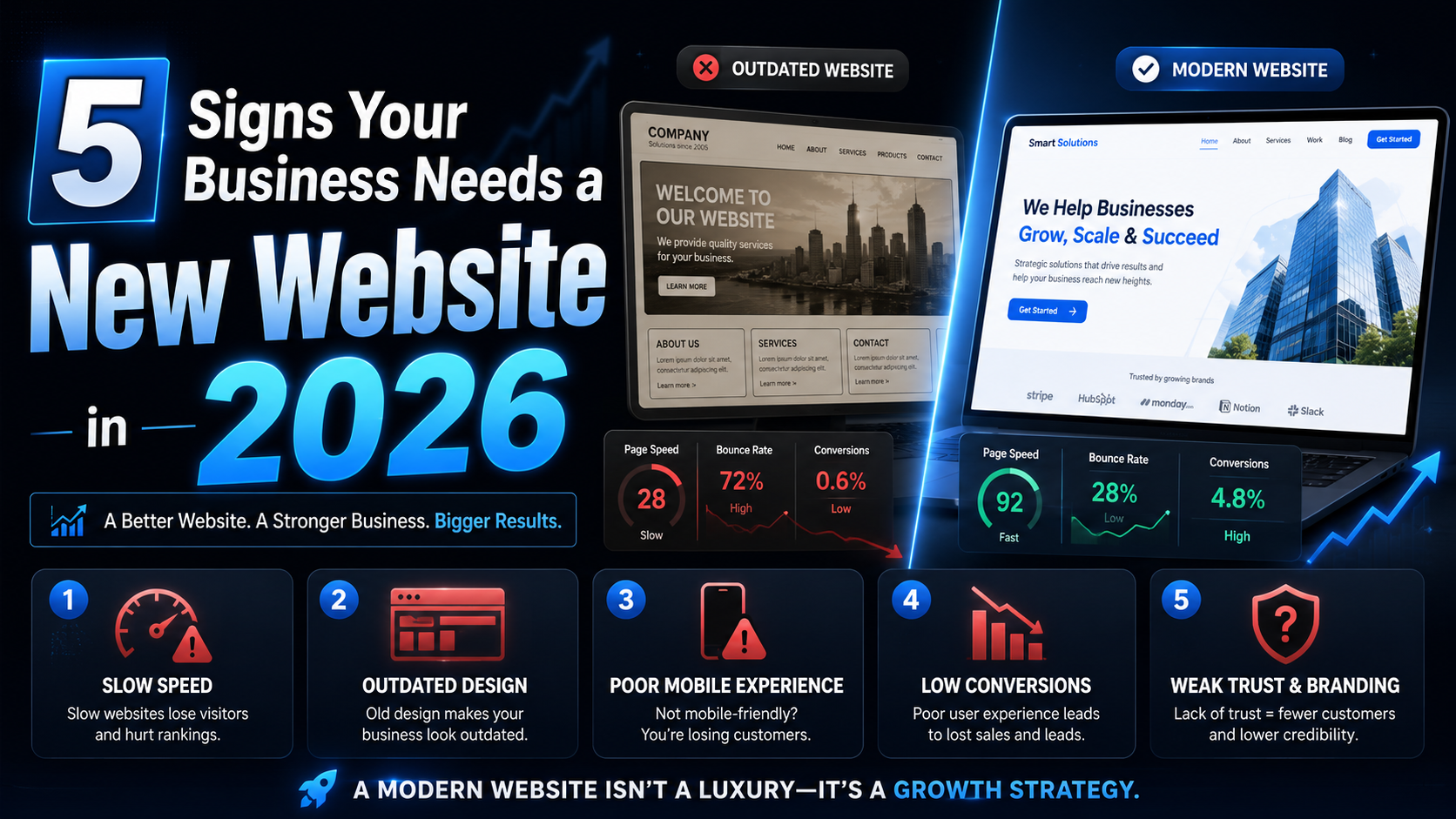
There is a particular kind of denial that Indian business owners have perfected over the years. The website was built four or five years ago, it cost a decent amount, it still "opens" when you type the URL, and therefore it must still be working. This logic is roughly equivalent to arguing that a shop with a broken shutter, flickering lights, and no signboard is still technically open for business. At Infinite Option, we audit websites for small and mid-sized businesses across India every single week, and the pattern is almost always the same — the owner has no idea their new website from 2021 is now actively repelling customers in 2026. The digital infrastructure that worked during the post-pandemic rush is not just outdated today; it is a measurable liability. What follows are five specific, diagnosable signs that your business needs a website redesign, not a minor tweak, not a colour change, but a ground-up rethink of your online presence.
Your Website Takes More Than Three Seconds to Load
This is not a suggestion from some abstract usability guideline. Google has published data confirming that 53 percent of mobile visitors abandon a site that takes longer than three seconds to load. For businesses in tier-2 and tier-3 Indian cities — where a significant chunk of your audience is browsing on budget Android devices over inconsistent 4G connections — page speed is not a luxury metric. It is the first filter your potential customer applies before they even see your homepage.
Most websites built between 2019 and 2022 carry bloated image files, uncompressed JavaScript libraries, and themes loaded with features nobody ever activated. The developer installed a multipurpose theme, toggled on a few widgets, and moved on. The result is a site that might load in two seconds on a fibre connection in Bengaluru but takes seven or eight seconds on a Jio connection in Raipur.
What Page Speed Actually Costs You
The relationship between page speed and bounce rate is not linear — it is exponential. A one-second delay beyond the three-second threshold does not lose you a few visitors. It can increase your bounce rate by over 30 percent, which means nearly a third of the people who clicked on your Google listing, your ad, or your WhatsApp link simply left before your page rendered. That is money already spent on SEO services or paid campaigns that evaporated because the landing destination could not keep up. If your current hosting is a shared plan on a budget Indian provider with servers routing through Singapore, no amount of plugin-level optimisation will fix the core problem. You need a new website built on a modern, lightweight architecture with Indian CDN nodes and properly optimised assets.
Your Site Is Not Built for Mobile-First Browsing
There is a difference between a website that is "mobile responsive" and a website that was designed for mobile first. Most Indian business websites fall into the first category — they were designed on a desktop screen, and someone checked that the layout did not break on a phone. That is not mobile-first design. That is desktop design with a responsive afterthought.
In 2026, over 78 percent of web traffic in India originates from mobile devices. Your user experience on a 6.5-inch screen is not a secondary concern. It is the primary interface through which your customers evaluate whether you are worth their time. A truly mobile-first web design accounts for thumb-reach zones, tap target sizes, font legibility without zooming, and streamlined navigation that does not require three menu taps to reach a contact form.
The UPI Checkout Test
Here is a practical test. Open your website on your phone. Try to complete the most important action a customer would take — whether that is filling a contact form, making a UPI payment through Razorpay, or requesting a quote. If it takes more than two taps and fifteen seconds, your conversion rate is suffering. If the form fields are misaligned, if the PhonePe or Google Pay button is hidden below the fold, or if the user has to pinch-zoom to read your pricing, that is not a minor inconvenience. That is a structural failure in your online presence that only a website redesign can address. No CSS patch will fix a layout that was never conceived for the device 80 percent of your audience is using.

Your Design Looks Like It Belongs in 2018
Visual design trends in web development move faster than most business owners realise. The full-width image sliders, the stock photos of handshakes in boardrooms, the gradient buttons with drop shadows — these were standard web design choices in 2018. In 2026, they signal one thing to a visitor: this business has not invested in itself in years.
This is not about aesthetics for the sake of aesthetics. It is about trust. A prospective customer comparing your website to a competitor with a clean, modern, fast-loading interface will subconsciously associate your outdated website with outdated services. This is particularly damaging for businesses offering professional services — consultants, agencies, clinics, law firms — where credibility is the entire transaction.
When Visitors Judge Before They Read
Research on web credibility from Stanford's Persuasive Technology Lab established that 75 percent of users judge a company's credibility based on its website design. Not its content. Not its testimonial section. Not its client list. The visual impression formed in the first 0.05 seconds determines whether the visitor stays to read or clicks back to the search engine ranking page. If your current site still uses a template that was popular during the Jio boom era, you do not need a refresh. You need a new website with a design language that matches the expectations of a 2026 audience — minimal layouts, fast interactions, system-native fonts, purposeful whitespace, and content-first hierarchy.
You Cannot Update Content Without Calling a Developer
This is one of the most expensive signs to ignore. If adding a new product to your catalogue, updating your GST-inclusive pricing, posting a blog entry, or changing your phone number requires you to email a freelancer and wait three days, your website is not a business tool. It is a dependency.
The businesses that build consistent online presence in 2026 are the ones publishing regular blog content, updating their services pages to reflect seasonal offers, and keeping their portfolio or testimonial sections current. If your website's backend is a static HTML file or a WordPress installation so heavily customised that only the original developer can navigate it, you have a bottleneck that costs you both time and search engine ranking visibility.
The Hidden Cost of Developer Dependency
Every time you pay a developer to make a minor text edit, you are not just spending money. You are losing the two or three days it takes for them to respond, make the change, and push it live. In that window, your website displays incorrect pricing, outdated offers, or missing products. Multiply that across twelve months, and you have a site that is perpetually out of sync with your actual business. When you build a website on a modern CMS with a properly structured admin panel, you eliminate this friction entirely. Your team — even someone with no technical background — should be able to update content, upload images, and publish posts without writing a single line of code.
Your Website Does Not Appear in AI-Powered Search Results
This is the sign that most Indian business owners are not even aware of yet, and it is arguably the most consequential. In 2026, a growing share of your potential customers are not typing queries into Google and clicking ten blue links. They are asking ChatGPT, Gemini, or Perplexity questions like "best web development services in Howrah" or "affordable custom website for small business in India," and the AI is generating a direct answer — often citing specific businesses.
Why GEO and AEO Demand Structural Changes
If your website is not structured for Generative Engine Optimisation and Answer Engine Optimisation, it is functionally invisible to this new discovery layer. AI models extract answers from websites that have clear heading hierarchies, structured data markup, concise entity-rich paragraphs, and content that directly answers specific questions. An outdated website built on a generic theme with vague, keyword-stuffed copy will not surface in these results — no matter how many years it has been sitting on the internet. This is not a content problem you can fix by adding a few pages. It is an architectural problem that requires you to start your own website project from scratch, built with GEO-readiness as a foundational layer rather than a retrofit.
What Happens When You Keep Ignoring These Signs
The compounding effect is what makes this dangerous. A slow, non-mobile-first, visually outdated website with a rigid backend and no AI-search visibility does not just underperform. It actively degrades your search engine ranking over time. Google's algorithm updates increasingly penalise sites with poor Core Web Vitals, weak mobile usability, and thin content. Your bounce rate climbs, your conversion rate drops, your competitors who did invest in a website redesign start outranking you, and the gap widens every quarter.
The cost of inaction is not zero. It is the cumulative value of every customer who visited, judged, and left. Every AI-generated answer that cited your competitor instead of you. Every inquiry that went to the business with a faster, cleaner, more trustworthy web design.
How to Plan Your Website Redesign Without Wasting Money
If you have identified two or more of these signs in your own site, the next step is not to panic-hire the cheapest freelancer on a marketplace. It is to approach the rebuild strategically.
Start by auditing your current site's performance data — page speed scores, mobile usability reports from Google Search Console, and bounce rate patterns from Analytics. Identify which pages actually drive inquiries and which are dead weight. Define the actions you want visitors to take and build your new website around those conversion paths. Choose a technology stack appropriate for your scale — a small services business does not need a React-based SPA, and a product catalogue with 500 items should not run on a basic WordPress theme. Factor in ongoing SEO services, content publishing capability, and the ability to start your own website updates without external dependency.
If your business relies on local discovery — and most Indian SMBs do — make sure your Google Business Profile, your website, and your content strategy are synchronised. A new website without a connected GBP and a regular blog publishing cadence is a car without fuel.
Final Word
Every business owner who reads this will fall into one of two categories: those who recognise these signs and act on them, and those who bookmark the page and revisit it six months later when the damage has compounded further. The web development services landscape in India has matured significantly — building a fast, mobile-first, AI-search-ready website in 2026 is neither as expensive nor as time-consuming as it was even three years ago. What it does require is working with a team that understands not just design and code but the strategic layer underneath — the SEO, the GEO readiness, the conversion architecture, and the content infrastructure that turns a website from a digital brochure into a functioning business asset. That is what Infinite Option builds, and if your current site is showing even two of these five signs, the cost of waiting will always be higher than the cost of starting.