
If your website not working on mobile India 2026 is something your customers are experiencing, you're handing business to your competitor every single day. Not slowly — immediately. A customer searches for your service on their phone, your site loads crooked or takes 6 seconds, and they're gone. No second chance. This checklist is for Indian small and medium business owners who want to fix that problem before it costs them another season of sales.
How Indian Customers Actually Use Mobile to Find and Buy in 2026
Let's start with the numbers, because they're hard to argue with. According to Statista's India internet report, 78–82% of all website traffic in India now comes from mobile devices. That's not a trend anymore — it's the default. And with 85%+ of Indian internet users on 4G or 5G mobile broadband, the desktop is practically a secondary screen.
Here's what makes this even more important for your business: Tier 2 and Tier 3 cities now account for 55%+ of new internet users in India, and almost all of them are mobile-only. A customer in Asansol, Durgapur, or Siliguri looking for your service isn't opening a laptop. They're on their phone, probably on Jio, and they expect your site to work instantly.
The 3-Second Rule
Google's research on page experience is clear: 53% of mobile users abandon a website if it takes more than 3 seconds to load. A 1-second delay alone reduces conversions by 20%. On a 4G connection, your site should load in under 2.5 seconds. If it doesn't, you're not just losing rankings — you're losing real customers in real time.
WhatsApp-First Behaviour
Indian buyers don't fill long forms. They tap WhatsApp. Before calling, before emailing, before anything — they look for a WhatsApp button. If your mobile site doesn't have a sticky WhatsApp button, you're making it harder for customers to reach you than it needs to be. That's a conversion problem, not a design preference.
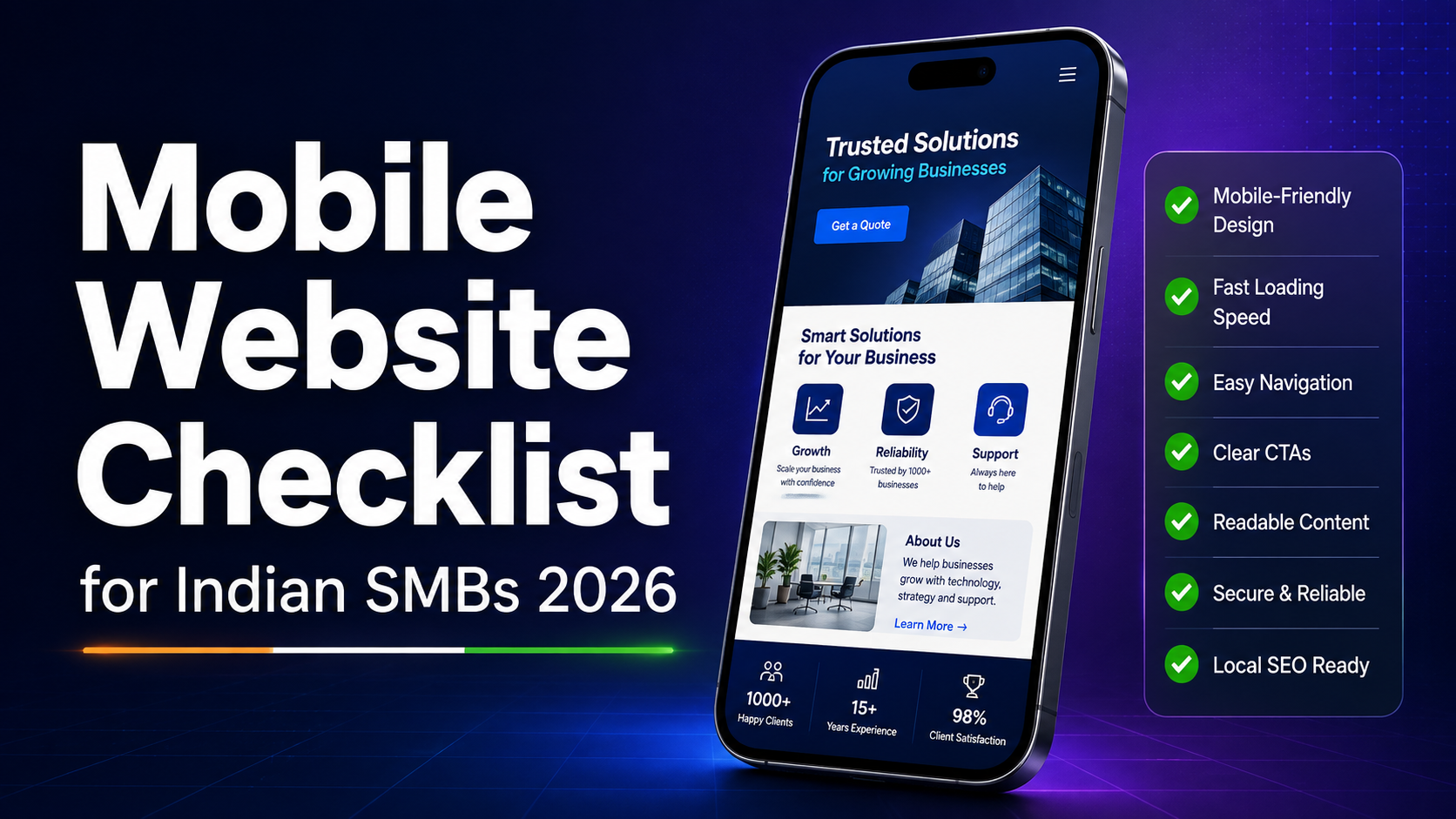
The 2026 Indian SMB Mobile Checklist — website not working on mobile India 2026 edition
Run through this honestly. If you fail 3 or more points, your site is actively losing customers right now.
Speed and Performance
UX and Design
Contact and Conversion
Local SEO on Mobile
"Near me" searches on mobile grew 150%+ in India over the last 3 years. If your local SEO isn't set up correctly, you won't appear in those searches regardless of how good your website looks.
Mobile SEO Basics
Google has been 100% mobile-first indexing since 2023. Your desktop version is irrelevant for ranking. Google crawls and ranks your mobile version. Period.
E-Commerce (if applicable)
Quick Self-Test in 60 Seconds
Open Chrome on your desktop. Right-click anywhere on your site → Inspect → click the phone icon (Toggle Device Toolbar). Select "iPhone 12" or "Galaxy S20". Reload the page. What you see is roughly what your mobile customers see. Check if buttons are tappable, text is readable, and the page doesn't break sideways. That's your starting point.
Custom PHP Website vs WordPress: Which Actually Performs Better on Mobile?
This is a question we get often, and the honest answer isn't popular among WordPress fans.
WordPress sites slow down on mobile because of plugin bloat. Every plugin adds code — CSS, JavaScript, database queries — whether you need it or not. A typical WordPress site with 15–20 plugins loads 3–5 MB of data on mobile. A custom PHP site built for the same purpose might load 600KB. That's not a small difference — that's the difference between a customer staying and leaving.
Custom PHP means only the code your site actually needs is there. No dead weight. No plugin conflicts. No theme that adds 200 lines of CSS you never use. At Infinite Option, 90% of our websites are built in custom PHP for exactly this reason — mobile speed is a direct result of clean, purposeful code.
When is WordPress acceptable on mobile? When the site is simple (5–8 pages, no complex features), the theme is lightweight (like Astra or GeneratePress), and plugins are kept to a minimum. A basic WordPress site with a good theme and 5 plugins can perform well. But the moment you add WooCommerce, a page builder, a slider plugin, and a form plugin — you're in trouble on mobile.
For growing businesses, custom web development is the better long-term foundation. You can add features without rebuilding from scratch.
Should You Build a Mobile App or Fix Your Mobile Website First?
Short answer: fix the website first. Always.
Mobile app development in India costs ₹50,000 to ₹2,00,000+ for a basic app, and that's before Play Store maintenance, annual developer fees, and the fact that most customers won't download an app from a business they haven't used before. Apps make sense for high-repeat-purchase businesses — food delivery, loyalty programmes, subscription services.
For most Indian SMBs — a salon in Kolkata, a coaching center in Howrah, a travel agent in Siliguri — a well-optimised mobile website does 90% of what an app does. It's accessible instantly, no download required, and it shows up in Google search results.
If you're somewhere in between, a Progressive Web App (PWA) is worth knowing about. It's a website that behaves like an app — can be added to the home screen, works offline partially, sends push notifications. It's a middle ground, but for most SMBs, it's still overkill before the basics are sorted.
How Much Does Mobile Website Optimisation Cost in India?
Here's where most business owners get confused. They think fixing a bad website is cheaper than building a new one. Sometimes it is — sometimes it isn't.
If your existing site is WordPress with 20 plugins and a heavy theme, fixing it properly might cost ₹8,000–₹15,000 in developer time, and you'll still have an unstable foundation. Building fresh on custom PHP at ₹12,000 gives you a faster, cleaner result that won't break every time a plugin updates.
Here's what a ₹12,000 mobile-ready website from Infinite Option actually includes:
For a basic presence, a mobile-ready website starts at ₹5,000. You can read a full honest breakdown in our post on how much a website costs in India in 2026.
Now do the ROI maths. If your broken mobile site loses you just one customer per week — at a conservative ₹500 average transaction — that's ₹26,000 lost in a year. A ₹12,000 one-time fix pays for itself in under 6 months. And that's assuming only one lost customer per week, which is almost certainly an undercount.
67% of Indian online shoppers say they won't return to a mobile site with a bad experience. You don't get a second chance to make that first mobile impression.
The hidden cost nobody talks about: freelancers who disappear after delivery, leaving you with a site you can't update and no one to call. That's a real risk. A registered company with a physical office and 70+ delivered projects is a different proposition — you can actually hold someone accountable.
Final Thoughts: Your Mobile Website Is Your Storefront — Treat It That Way
Indian buyers decide in seconds on mobile. They see your site load slowly, or a button they can't tap, or a form that's broken on their screen — and they leave. 88% of local mobile searches result in a call or store visit within 24 hours. That's your customer, ready to buy, and your mobile site is either helping or hurting that moment.
Run the checklist above honestly. If you fail 3 or more points, your site is losing customers today — not eventually, today. And if the problem is a website not working on mobile India 2026, the fix doesn't require a big budget. A professional mobile-ready website starts at ₹5,000, and a full solution with domain, hosting, SSL, and Admin CRM is ₹12,000.
Also worth reading: our post on 7 proven reasons your website isn't working on mobile — it goes deeper on the technical side if you want to diagnose specific issues.
If you want a free mobile audit of your current website, WhatsApp the Infinite Option team — we'll check your site and tell you honestly what's broken and what it would take to fix it. No sales pressure, just a straight answer.