
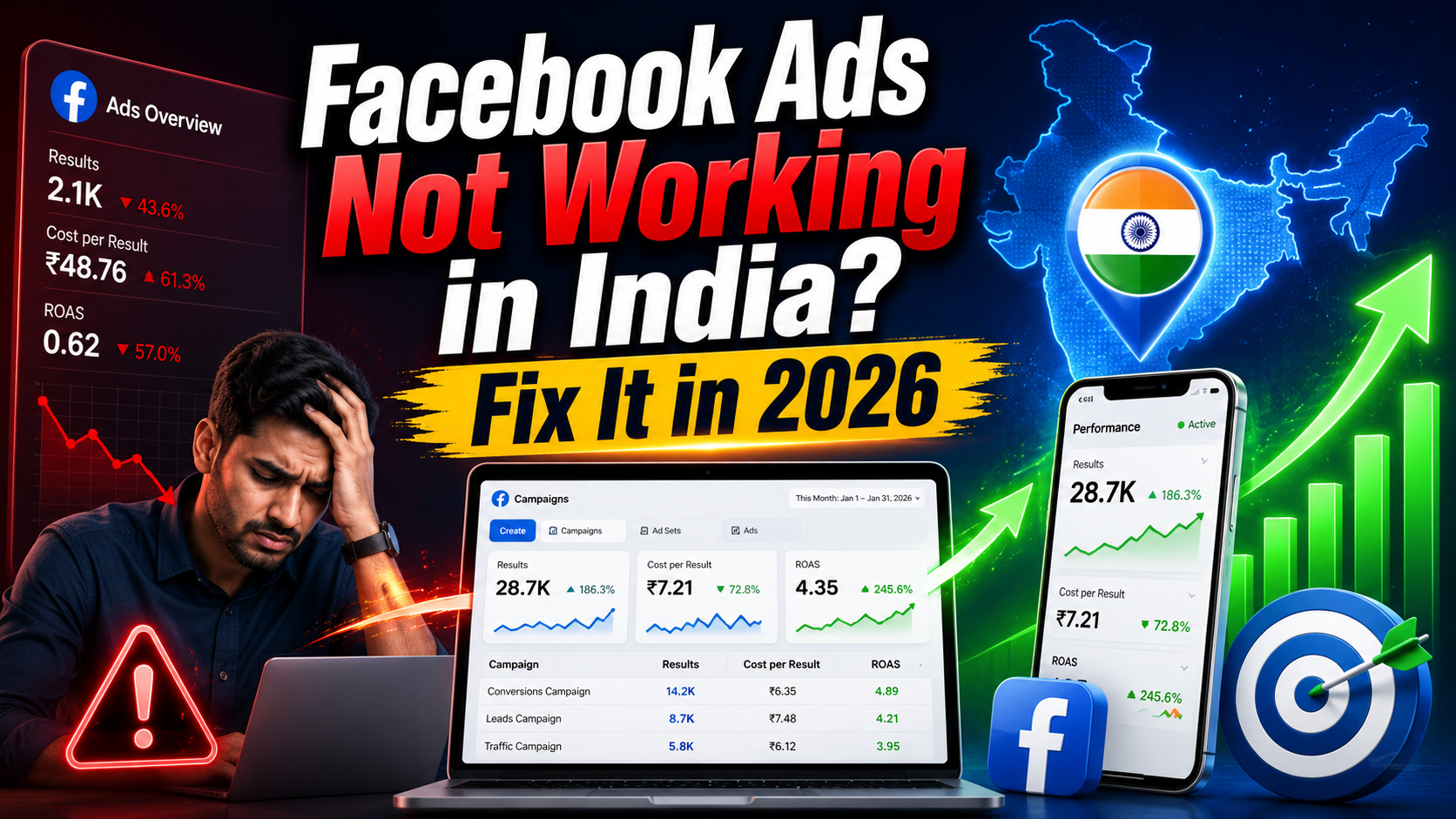
Why are my Facebook ads not working in India and how do I fix them?
Facebook ads fail in India mainly due to wrong campaign objectives, poor targeting, and creatives that ignore local buying psychology. Switch to the Lead Generation objective, target audiences of 50,000–3,00,000 people aged 28–45, use vernacular language copy, and choose real local photos over stock images to see results.
If your facebook ads not working india is the search you just typed at 11pm, staring at ₹8,000 spent and zero leads — you're not alone. Most Indian small business owners run into the same wall. The problem is almost never the budget. It's the setup. Let's go through exactly what's broken and how to fix it before you spend another rupee.
The Real Reason Your Facebook Ads Aren't Generating Leads in India
Indian audiences behave differently from audiences in the US or UK. A campaign template that works for a London real estate agent will not work for a coaching center in Patna or a salon in Howrah. The buying psychology is different, the scroll behavior is different, and the trust signals are different.
Most agencies — and most DIY campaigns — copy global ad frameworks without changing anything for the Indian market. That's the root of the problem. Specifically, there are three things that kill most campaigns:
Before you touch your budget, do a quick self-audit. Ask yourself: Did I choose "Lead Generation" as my campaign objective? Is my ad copy in the language my customer actually thinks in? Does my landing page or lead form load in under 3 seconds on a 4G connection? If the answer to any of these is no — that's your problem, not your budget.
You're Using the Wrong Objective and Targeting Setup
This is the single most common reason facebook ads don't work in India. When you choose the Traffic objective, Facebook optimises to get you clicks — cheap clicks, from people who click everything. It does not care whether those people ever fill a form or call you. You want the Lead Generation objective. Full stop.
Targeting is the second issue. Broad targeting in Tier 2 and Tier 3 cities gives you a low CPM (sometimes as low as ₹40 per 1,000 impressions), but the intent is very low. You're reaching people who are bored, not people who are looking for your service. On the other hand, hyper-narrow targeting — say, 500 people in a single locality — starves the algorithm. It can't learn fast enough.
The sweet spot for most Indian SMBs is an audience of 50,000 to 3,00,000 people in your relevant geography, filtered by interest and age. Speaking of age — most Indian buyers in service categories like education, home improvement, healthcare, and finance are between 28 and 45 years old. If you're targeting 18–24 because "they're on Facebook more," you're talking to the wrong room.
Set up your campaign like this: choose Lead Generation → create an Ad Set → set location to your city or district → age 28–45 → add 2–3 relevant interests → keep audience size between 50K and 3L → create your Instant Form. That's the baseline.
Your Ad Creative and Copy Are Ignoring How India Actually Thinks
According to research from Statista's India internet reports, vernacular language content consistently outperforms English-only content in engagement across Tier 2 and Tier 3 cities. Ads in Hindi, Bengali, Tamil, or Marathi show 20–40% better engagement than English-only ads in these markets. If your customer thinks in Bengali, write your headline in Bengali. It's that simple.
Stock photo creatives get scrolled past in under a second. Real photos — your actual shop, your actual team, a real customer's face — stop the thumb. People in India respond to familiarity and local context. A photo of a smiling family in a generic Western kitchen means nothing to someone in Kolkata looking for an interior designer.
Price anchoring works extremely well in India. Show the original price, show the offer price, show the deadline. "Website starting ₹12,000 — includes domain, hosting, and CRM. Offer valid this week only." That's a complete ad.
For format: in 2026, short video (15–30 seconds) outperforms static images for lead generation in most Indian niches. But a well-designed static with a clear offer still works if your budget doesn't allow video production. Don't let perfect be the enemy of running something.
A simple copy formula that converts: State the problem → Show local proof → Give a clear CTA. Example: "Still paying rent for a shop but no one finds you online? 70+ businesses in West Bengal now get leads through their website. WhatsApp us today — setup starts at ₹1,500."
Instant Form vs Landing Page: Which Works Better in India?
Instant Forms (Facebook Lead Ads) have lower friction. The form opens inside Facebook, pre-fills the user's name and phone number, and they submit in two taps. For a mobile-first country where 70%+ of Facebook users are on mobile only, this matters a lot.
The downside: Instant Form leads are often low intent. People submit without reading what they signed up for. You'll get 20 leads and 15 of them won't pick up the phone. This is a known problem with facebook ads in India, especially in competitive niches.
Landing pages qualify the lead better — someone who reads your page, scrolls through your offer, and fills a form is genuinely interested. But your landing page must load fast. According to Google's Page Experience guidelines, pages that load in under 2.5 seconds see significantly better conversion rates. In India, where many users are on 4G with fluctuating speeds, a slow page kills conversions. If you need help with a fast-loading page, web development done right makes a real difference here.
The practical approach: use Instant Form for awareness campaigns and lower-ticket services. Use a landing page for high-ticket services (above ₹15,000) where lead quality matters more than lead volume. If you use a landing page, install the Facebook Pixel and track the Thank You page as a conversion event — otherwise you're flying blind.
If you stick with Instant Form: keep it to 3 fields maximum — name, phone number, city. Research shows that adding more than 5 questions to a lead form drops completion rate by 40–60%. Don't ask for email, business name, and annual turnover on a mobile form. You'll lose them.
You're Losing Leads to Fake Clicks, Ad Fatigue and a Missing Pixel
No Pixel means you cannot retarget website visitors, build lookalike audiences, or tell Facebook which leads actually converted. You're essentially asking Facebook to optimise for nothing. Install the Pixel through Meta Business Suite → Events Manager → Connect Data Sources → Web. Use the Meta Pixel Helper Chrome extension to verify it's firing correctly on every page.
Fake leads and accidental clicks are a real problem with Indian facebook ads. Add a confirmation question to your Instant Form — something like "Are you looking for this service in the next 30 days? Yes / No." It adds one second of friction and filters out people who tapped by mistake.
Ad fatigue sets in fast in India, especially with small audience sizes. When your ad frequency crosses 2.5 (meaning the average person has seen it 2.5 times), engagement drops and cost per lead goes up. Refresh your creative every 10–14 days. Change the image, change the headline, keep the offer the same.
Retargeting warm audiences — people who watched 50% of your video, visited your website, or engaged with your Facebook page — costs 60–70% less per lead than cold audience campaigns. This is where the Pixel pays for itself.
Finally: if your total monthly budget is below ₹5,000, your campaign will likely never exit Facebook's Learning Phase. The algorithm needs a minimum of 50 conversion events in 7 days to optimise properly. At ₹150 average cost per lead, that's ₹7,500 just to exit learning. The minimum viable spend for most Indian SMBs is ₹500–₹1,000 per day. You can read more about realistic ad budgets in our guide on how much Facebook ads cost in India in 2026.
Fix the Foundation Before Increasing Your Budget
More budget on a broken campaign means faster money loss, not more leads. The fix order matters:
Most Indian SMBs who fix these five things see a real difference within 7–10 days. The leads don't just increase — the quality improves because you're reaching the right people with the right message. For more on building a digital presence that supports your ads, check out our thoughts on digital marketing for Indian businesses and why your website's speed and structure matter just as much as your ad creative. You might also find our post on why websites don't work on mobile useful if your landing page is the weak link.
According to HubSpot's marketing research, only 2–5% of people who click a Facebook ad actually fill a lead form — which means every part of the funnel has to work together. Fix one thing and the others still leak.
At Infinite Option, we set up Facebook and Instagram ad campaigns for ₹1,500 — that includes audience research, ad creative, copy, and campaign launch. If the campaign isn't performing, we fix it for free. No retainer, no lock-in. If you're tired of guessing, talk to us and we'll tell you honestly what's wrong with your current setup before you spend anything more.