
Overview
Here is the uncomfortable truth about website cost in India that most agencies, freelancers, and website maker platforms will never tell you upfront: the number you see in a quote is almost never the number you actually end up paying. A freelancer quotes fifteen thousand rupees. An agency quotes one and a half lakhs. A DIY website maker advertises "free forever." All three numbers are technically accurate. And all three are misleading in their own way.
The Indian market for website design and development has matured significantly by 2026, but pricing transparency has not kept pace. Business owners in Surat and Siliguri, Pune and Patna are all asking the same question before they commit a single rupee: what does a website actually cost when you account for everything? Not just the upfront build, but the hosting, the maintenance, the GST, the renewal trap, and the hidden plugin fees that quietly show up three months after launch.
This post is the honest breakdown. No inflated ranges designed to upsell you into a premium package. No suspiciously low numbers designed to get your foot in the door. Just a clear, category-by-category accounting of what website cost in India looks like in 2026, so you can budget with your eyes open.
The Real Problem With Website Cost Quotes in India
Before looking at any numbers, you need to understand why website cost estimates in India are so wildly inconsistent. Ask five different providers what a business website costs, and you will get five answers ranging from eight thousand to three lakhs. That is not because some providers are scammers and others are saints. It is because "website" is not a single product. It is a category.
Comparing a template-based WordPress site to a custom-coded web application is like comparing a Maruti Alto to a Toyota Fortuner. Both are cars. Both get you from point A to point B. But nobody would call them the same product, and nobody should expect them to cost the same amount.
The confusion intensifies because many providers in India deliberately blur these categories. A website maker platform might advertise a website for three hundred rupees per month, which sounds absurdly cheap until you realise that price covers only the most basic tier with no custom domain, no removal of platform branding, and no real SEO capability. An agency might quote two lakhs for "website design and development," but that quote might or might not include hosting, content writing, SEO setup, payment gateway integration, or post-launch support.
The first step toward understanding website cost in India is accepting that the question itself needs to be more specific. What type of website? What platform? What features? What level of ongoing support? The answers to those sub-questions determine everything.
Website Cost in India by Type: The 2026 Numbers
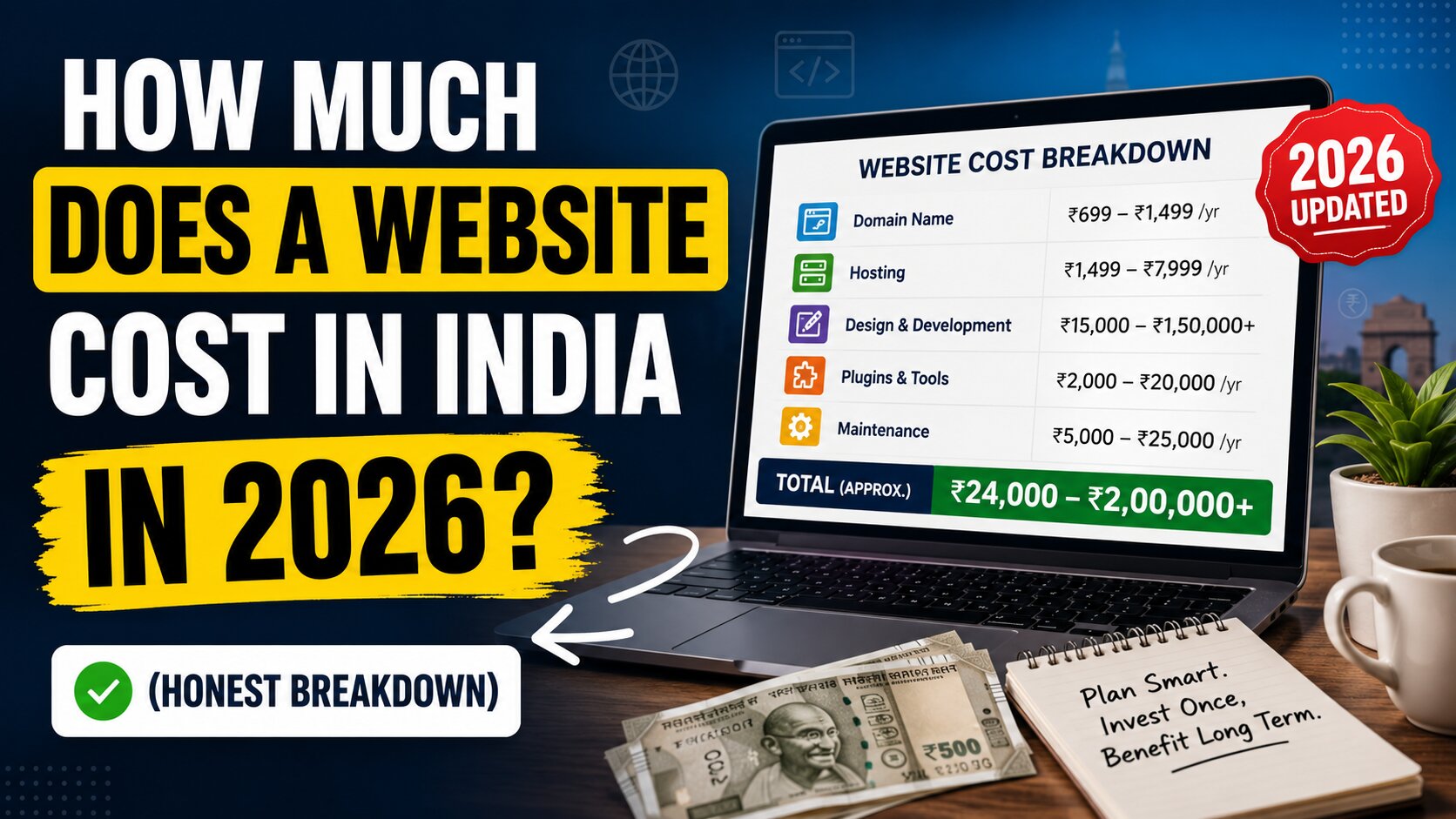
This is where most business owners want to start, so here are the actual ranges based on current Indian market pricing. These figures include website design, development, and basic on-page SEO, but exclude ongoing monthly costs, which are covered separately below.
Static or Brochure Website (5 to 10 Pages)
A static website is the digital equivalent of a business card. It presents your business name, services, contact details, and maybe a few testimonials. No blog, no login portal, no dynamic content. For a kirana store owner in a tier-2 city who simply needs an online presence for Google searches and WhatsApp sharing, this is often sufficient.
The website cost for a basic static site in India ranges from ten thousand to thirty thousand rupees when built by a freelancer or small agency. Template-based builds using a website maker like Starter Sites or basic WordPress themes sit at the lower end. Sites that involve even modest custom website design work push toward the higher end of that range. If someone quotes you less than ten thousand for a static site in 2026, be cautious. That number almost certainly excludes domain registration, hosting, SSL, or GST, all of which will appear later as separate charges.
CMS-Based Business Website (10 to 30 Pages)
This is the workhorse of Indian SMB websites. A CMS-based site, typically built on WordPress, gives you the ability to update content yourself, publish blog posts, capture leads through contact forms, and integrate basic analytics. Most service-based businesses, from chartered accountants in Kolkata to interior designers in Bengaluru, fall into this category.
The website cost in India for a CMS-based business site ranges from twenty-five thousand to one lakh rupees. The wide range exists because this category absorbs enormous variation in website design quality, number of pages, plugin requirements, and content complexity. A twenty-five thousand rupee WordPress site uses a premium theme with minimal customisation. A one-lakh-rupee site involves custom UI design, multiple lead capture mechanisms, speed optimisation, schema markup, and thorough mobile responsiveness testing.
For most Indian SMBs, the sweet spot sits between forty thousand and seventy thousand rupees. That range gets you a professionally designed, SEO-ready, mobile-first website without unnecessary feature bloat.
E-Commerce Website
If you are selling products online and need a cart, checkout, payment gateway, inventory management, and order tracking, the website cost escalates meaningfully. E-commerce website design demands more technical layers, more security considerations, and more post-launch testing than a standard business site.
In India, an e-commerce website built on WooCommerce or Shopify typically costs between fifty thousand and two and a half lakh rupees. The lower end covers a WooCommerce store with up to fifty products, a standard theme with customisation, Razorpay or PhonePe payment integration, and basic shipping configuration. The higher end involves custom website design, hundreds of product listings, multi-vendor functionality, advanced filtering, GST-compliant invoicing, and integration with logistics APIs like Shiprocket or Delhivery.
Shopify-based stores carry an additional monthly platform fee of approximately two thousand to six thousand rupees per month depending on the plan, which is a recurring cost that WordPress or WooCommerce-based stores avoid. However, Shopify reduces development complexity, so the initial build cost is often ten to twenty percent lower. The tradeoff depends on whether you prioritise lower upfront cost or lower long-term cost.
Custom Web Application
If your requirements include user dashboards, role-based access, real-time data processing, API integrations with third-party platforms, or complex business logic, you are no longer building a website in the traditional sense. You are building a web application.
Custom web application development in India starts at approximately one lakh rupees for a relatively simple tool and can reach ten lakhs or more for enterprise-grade platforms. This category is where quoting becomes genuinely difficult because no two custom builds share the same scope. A booking platform for a salon chain has fundamentally different requirements from an inventory management portal for a manufacturing unit.
For Indian businesses evaluating this category, the critical advice is this: do not accept a fixed-price quote for a custom web application without an extremely detailed scope document. The website cost for custom projects is almost entirely determined by scope, and scope creep is the single most expensive risk in this category.
The Costs Nobody Puts in the Headline
The build cost is only the first chapter of the story. The ongoing and ancillary costs are where Indian business owners most frequently get blindsided, and where the actual website cost in India per month becomes relevant.
Domain Registration
A .com domain costs between seven hundred and twelve hundred rupees per year through Indian registrars like GoDaddy, Hostinger, or Bigrock. A .in domain is marginally cheaper, typically five hundred to eight hundred rupees per year. Domain prices are relatively standardised and rarely a source of hidden costs, though some agencies mark up domain registration by two to three times when bundling it into a package. Always check what you would pay if you registered the domain yourself.
Web Hosting
Hosting is where the monthly cost picture starts to take shape. Shared hosting in India starts as low as sixty-nine rupees per month with providers like Hostinger during promotional pricing, though the renewal rate typically jumps to three hundred to five hundred rupees per month. For a small business website with moderate traffic, shared hosting between one hundred fifty and five hundred rupees per month is adequate.
VPS hosting, which becomes necessary as your traffic grows or your site requires more processing power, ranges from four hundred to three thousand five hundred rupees per month for managed plans in India. Cloud hosting on AWS Mumbai or DigitalOcean Bangalore starts at approximately three hundred to six hundred rupees per month for a basic instance.
The trap here is promotional pricing. A website maker or hosting provider advertising sixty-nine rupees per month requires a forty-eight-month upfront commitment, and the renewal price after that term can be three to four times higher. Budget based on renewal rates, not introductory rates, because the introductory price only applies once.
SSL Certificate
SSL is no longer optional. Google penalises non-HTTPS sites in search rankings, and browsers display aggressive "Not Secure" warnings that destroy visitor trust. The good news: most hosting providers in India now include a free SSL certificate (Let's Encrypt) with their plans. If someone charges you separately for basic SSL in 2026, that is a red flag. Premium SSL certificates with extended validation cost between three thousand and fifteen thousand rupees per year, but most SMBs do not need them.
GST
This is the cost component that catches first-time buyers off guard. All digital services in India, including website design, development, hosting, domain registration, and maintenance, attract eighteen percent GST. A website quoted at fifty thousand rupees actually costs fifty-nine thousand rupees after GST. On a two-lakh project, that is an additional thirty-six thousand rupees. Always confirm whether a quote is GST-inclusive or GST-exclusive before comparing prices across providers.
Online Website Cost in India Per Month: The Ongoing Reality
The one-time build cost gets all the attention, but the online website cost in India per month is what determines whether your website remains a functional business asset or gradually decays into a slow, insecure liability.
For a standard CMS-based business website, expect the following monthly recurring costs: hosting at one hundred fifty to five hundred rupees, security monitoring and plugin updates at five hundred to two thousand rupees if handled by an agency, content updates or blog publishing at two thousand to five thousand rupees if outsourced, and periodic technical maintenance at one thousand to three thousand rupees. The total monthly outlay for maintaining a small business website in India typically falls between two thousand and ten thousand rupees, depending on how much you handle internally versus outsource.
E-commerce websites cost more to maintain. Product catalogue updates, payment gateway monitoring, order system testing, and security patching push the website cost in India per month to between five thousand and twenty thousand rupees for most online stores.
The businesses that skip maintenance to save money almost always pay more in the long run. A hacked website costs far more to recover than it costs to protect. A site that drops from page one of Google due to neglected Core Web Vitals costs far more in lost leads than a few thousand rupees per month in performance monitoring. Maintenance is not optional. It is the insurance premium on your digital asset.
Freelancer vs. Agency vs. DIY Website Maker: An Honest Comparison
Indian business owners typically have three paths to getting a website built, and each carries distinct tradeoffs that directly impact website cost and long-term outcomes.
A freelancer typically charges the lowest upfront rate, with basic website design starting at eight thousand to twenty-five thousand rupees. The advantage is cost savings and sometimes faster turnaround. The risk is accountability. If a freelancer disappears mid-project, becomes unavailable for post-launch fixes, or delivers subpar work, your recourse is limited. Freelancers work best for simple, well-defined projects where the scope is unlikely to change.
An agency charges more, typically starting at thirty thousand rupees and scaling to several lakhs for complex projects. In exchange, you get a team with defined processes, a project manager as your point of contact, broader skill coverage across website design and development and SEO, and contractual accountability. For businesses where the website is a primary revenue channel rather than just a digital business card, the agency model usually delivers better ROI despite the higher upfront cost.
A DIY website maker like Wix, Squarespace, or Hostinger AI Website Builder is the lowest-cost entry point, with plans starting at two hundred to five hundred rupees per month. These platforms are genuinely useful for solo entrepreneurs, personal portfolios, or micro-businesses testing an idea before committing to a full build. However, they impose significant limitations on customisation, SEO control, page speed optimisation, and scalability. A website maker is a starting point. For most businesses that intend to grow, it is not the endpoint.
The Pricing Traps Indian Businesses Fall Into
Understanding website cost in India also means understanding the patterns that lead to overspending or, worse, underspending followed by expensive rebuilds.
The first trap is chasing the lowest quote. A website built for eight thousand rupees almost always needs to be rebuilt within twelve to eighteen months because it lacks mobile responsiveness, page speed optimisation, structured data markup, or basic security hardening. The rebuild costs more than it would have cost to build properly the first time.
The second trap is paying for features you do not need. An agency that insists every small business needs a custom-coded website with React frontend and Node.js backend is overselling. Most Indian SMBs are perfectly well-served by a WordPress-based site with thoughtful website design and proper on-page SEO. Overengineering increases cost without proportional benefit.
The third trap is ignoring renewal and recurring costs. That three-year hosting deal at ninety-nine rupees per month becomes four hundred and ninety-nine rupees per month at renewal. That "free" SSL certificate included with a website maker disappears when you downgrade your plan. That premium theme requires a yearly license renewal. These recurring costs are part of the true website cost in India, and they should be factored into your budget from day one.
How to Budget for a Website in India in 2026
If you are an Indian SMB planning to invest in a website this year, here is a practical budgeting framework based on the numbers above.
For a service-based business that needs a professional online presence with lead capture, blog capability, and local SEO foundations, budget between forty thousand and eighty thousand rupees for the initial build, plus three thousand to seven thousand rupees per month for hosting, maintenance, and content. That translates to a first-year total of approximately seventy-five thousand to one lakh sixty thousand rupees, inclusive of GST.
For an e-commerce business, budget between eighty thousand and two lakh rupees for the build, plus seven thousand to fifteen thousand rupees per month for hosting, maintenance, catalogue management, and payment gateway monitoring. First-year total: approximately one lakh sixty thousand to four lakh rupees.
These are not the cheapest possible numbers. They are the realistic numbers for a website that actually performs, stays secure, ranks in search, loads fast on a Jio connection in a tier-3 town, and generates measurable business value.
Where Infinite Option Fits
At Infinite Option, we build websites for Indian businesses with full transparency on cost, scope, and ongoing requirements. No hidden fees that surface after the contract is signed. No artificially low quotes that balloon once the project starts. If you are evaluating website cost for your business and want a detailed proposal that accounts for everything discussed in this post, reach out for a consultation. We will walk you through exactly what your specific requirements will cost and why.
Final Word
The question "how much does a website cost in India?" does not have a single answer, and anyone who gives you one without asking about your business goals, target audience, required features, and growth plans is guessing. What this breakdown gives you is the framework to evaluate any quote you receive, whether it comes from a freelancer, an agency, or a website maker platform. Know what you are paying for. Know what is excluded. Know what the ongoing costs look like. And budget for the website your business actually needs, not the cheapest version that technically exists.