
Overview
Every Indian small business owner eventually arrives at the same fork in the road. You need a website. You have spoken to two or three developers. One says WordPress is the obvious choice. Another insists that a custom PHP website is the only serious option. Both sound convincing. Both claim their approach is better for your business. And you are left wondering whether you are about to make a decision that costs you lakhs in wasted money or years in lost opportunity.
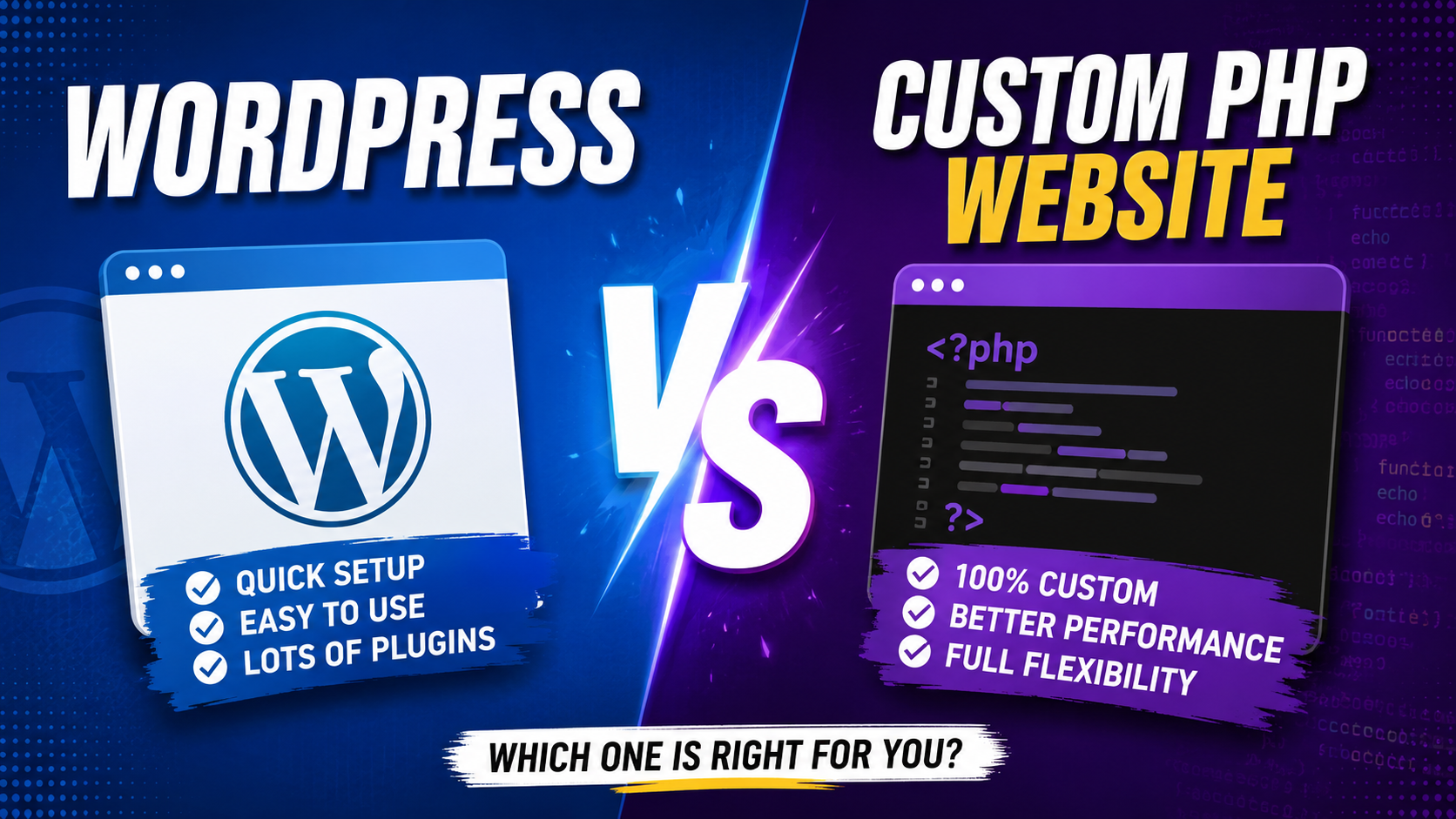
Here is what neither side usually tells you upfront: this is not a question with a universal right answer. WordPress powers 43.5 percent of all websites on the internet in 2026. That is a staggering dominance that no other platform comes close to matching. But dominance does not mean suitability for every use case. Custom PHP development exists for a reason, and that reason is not ego or overengineering. It is precision. The right choice depends entirely on what your business actually needs today, what it will need in two years, and how much you are prepared to spend maintaining either path.
This post breaks down both options with the specificity that Indian small businesses deserve. Not vague generalisations, but real cost comparisons in rupees, real performance benchmarks, real maintenance realities, and real scenarios where one option clearly outperforms the other. If you are evaluating web development services for your business, this is the comparison you need before you sign anything.
What WordPress Actually Is (And What It Is Not)
Most business owners in India have heard the name WordPress, but surprisingly few understand what it actually is at a technical level. This misunderstanding leads to poor decisions in both directions: businesses that choose WordPress without understanding its limitations, and businesses that reject it without understanding its strengths.
WordPress is an open-source content management system built on PHP and MySQL. It was originally designed for blog publishing but has evolved into a general-purpose website platform over the past two decades. When someone builds you a wordpress website, they are installing the WordPress core software on a web server and then layering on wordpress themes for visual design and plugins for extended functionality. The admin dashboard gives you the ability to update pages, publish blog posts, manage media, and control basic settings without touching any code.
The critical point to understand is that WordPress itself is not writing custom code for your business. It is assembling pre-built components. A wordpress theme controls how your site looks. Plugins control what your site does. The developer's job is selecting, configuring, customising, and sometimes modifying these components to match your requirements. This is fundamentally different from custom PHP development, where every line of code is written specifically for your project.
Neither approach is inherently superior. They serve different needs at different price points with different tradeoffs. The problem starts when someone sells you one while your business actually needs the other.
What Custom PHP Development Actually Means
A custom PHP website is built from scratch using PHP as the server-side programming language. There is no pre-installed CMS, no theme marketplace, no plugin repository. The developer writes the database structure, the backend logic, the frontend templates, and the admin panel specifically for your business requirements. Every feature exists because it was deliberately coded for your use case.
In India, custom PHP development typically uses frameworks like Laravel, CodeIgniter, or Symfony rather than raw procedural PHP. These frameworks provide standardised structures for routing, database interaction, authentication, and security, which significantly reduce development time and improve code quality compared to writing everything from zero.
The key advantage of custom PHP is control. There is no unnecessary code loading in the background. No plugin conflicts to debug. No theme updates that break your layout overnight. No wordpress themes imposing structural constraints on your design. Every database query is optimised for your specific data patterns. Every page loads exactly what it needs and nothing more.
The key disadvantage is cost and dependency. Custom PHP development requires significantly more development hours, which translates to higher upfront investment. And because the codebase is unique to your project, ongoing maintenance requires a developer who understands that specific codebase. You cannot simply watch a YouTube tutorial and update your own content the way you can with WordPress.
The Cost Comparison That Actually Matters for Indian SMBs
Cost is the first filter for most Indian small businesses, and rightfully so. A chai shop owner in Howrah and a SaaS startup in Gurugram have fundamentally different budgets, and the right platform for each is shaped heavily by what they can invest both upfront and monthly.
WordPress Website Cost in India
A professionally built wordpress website for an Indian small business typically costs between twenty thousand and one lakh rupees in 2026. This range covers a CMS-based site with ten to twenty pages, a premium wordpress theme with customisation, essential plugins for SEO and security, contact forms, mobile responsiveness, and basic speed optimisation. Developers or agencies offering web development services for WordPress usually include on-page SEO setup, Google Analytics integration, and initial content upload within this range.
For wordpress ecommerce, the cost increases. A WooCommerce-based online store with up to one hundred products, Razorpay or PhonePe payment gateway integration, shipping calculator, GST-compliant invoicing, and order management typically costs between fifty thousand and two lakh rupees. WooCommerce itself is free, but the premium plugins required for a production-ready Indian e-commerce store, including payment gateways, tax modules, and shipping integrations, add fifteen thousand to forty thousand rupees in licensing costs.
The monthly recurring cost for a wordpress website in India includes hosting at one hundred fifty to five hundred rupees for shared hosting, plugin license renewals averaging three to eight thousand rupees per year, security monitoring, and periodic updates. Total monthly maintenance runs between two thousand and eight thousand rupees for most SMBs.
Custom PHP Website Cost in India
A custom PHP website for an Indian small business starts at approximately seventy-five thousand rupees for a relatively simple informational site and scales to three to five lakh rupees for a feature-rich business platform with user dashboards, custom admin panels, API integrations, and role-based access. For custom e-commerce with proprietary cart logic, inventory management, and payment processing, costs can reach five to eight lakh rupees or more.
Monthly maintenance for a custom PHP site is typically higher because updates and fixes require a developer who understands the custom codebase. Budget five thousand to fifteen thousand rupees per month for ongoing php website development support, depending on complexity. Hosting costs are comparable to WordPress, though custom PHP applications often benefit from VPS hosting at four hundred to three thousand rupees per month rather than shared hosting.
The cost gap is real but not as dramatic as it first appears. A wordpress website that costs sixty thousand upfront but requires a full rebuild in eighteen months because it cannot handle your growing requirements has effectively cost you one lakh twenty thousand. A custom PHP site that costs one and a half lakh upfront but serves you for four years without structural changes may deliver better value per year. Cost analysis should always account for the total lifecycle, not just the launch invoice.
Performance and Speed: Where the Technical Gap Shows
Page speed is not a vanity metric. Google uses Core Web Vitals as a ranking signal, and Indian users accessing your site on Jio or Airtel 4G in tier-2 and tier-3 towns have zero patience for slow-loading pages. Performance is where the architectural differences between WordPress and custom PHP become measurable and consequential.
A well-optimised wordpress website with caching plugins like WP Rocket or LiteSpeed Cache, a CDN, WebP image conversion, and a minimal number of active plugins can achieve PageSpeed scores of 85 to 92 on mobile. That is genuinely good and more than sufficient for most business websites. The problem is that "well-optimised" is a qualifier that many WordPress sites never achieve. The average wordpress website loads twenty to thirty plugins, several of which inject JavaScript and CSS files on every page regardless of whether that page uses the plugin's functionality. WordPress themes, even premium ones, often include features you never activate but whose code still loads in the background.
A properly built custom PHP site routinely achieves PageSpeed scores of 95 to 100 because it loads zero unnecessary code. Every script, every stylesheet, every database query exists because the developer deliberately put it there for a specific purpose. There is no plugin overhead, no theme bloat, no unused module slowing down the page.
For most Indian SMB websites with moderate traffic, optimised WordPress is more than adequate. The performance gap becomes material when your site handles high traffic volumes, runs complex database queries, or competes in search verticals where the difference between an 88 and a 97 PageSpeed score translates into ranking positions. If your business depends on SEO services and organic search visibility in competitive niches, performance becomes a genuine differentiator.
Security: The Risk Most Indian SMBs Underestimate
WordPress sites face approximately ninety thousand attacks per minute globally, and ninety-seven percent of WordPress security vulnerabilities originate in plugins and wordpress themes rather than in the core WordPress software. That statistic deserves attention because it reframes the security discussion. WordPress core is reasonably secure when kept updated. The vulnerability surface expands with every plugin you install.
For an Indian small business running a wordpress website with fifteen to twenty plugins, the security maintenance burden is real. Every plugin is a potential entry point for attackers, and plugin developers vary wildly in their commitment to security patching. A single outdated plugin with a known vulnerability can result in your site being hacked, defaced, injected with malware, or blacklisted by Google. Recovery from a hack typically costs ten to thirty thousand rupees in emergency developer fees and can result in weeks of lost search visibility.
A custom PHP website built on a modern framework like Laravel has a significantly smaller attack surface because there are no third-party plugins introducing unknown code. Security is baked into the architecture rather than bolted on through plugins. This does not make custom PHP sites immune to attacks, but it does mean the security posture is more predictable and easier to maintain. The developer controls every line of code and can audit the entire codebase without depending on third-party vendors to issue patches.
If your website handles sensitive customer data, processes payments through Indian gateways like Razorpay or CCAvenue, or operates in a regulated industry, the security argument for custom PHP carries significant weight. If your site is primarily informational with standard contact forms, WordPress with disciplined plugin management and a quality security plugin like Wordfence is generally sufficient.
SEO Capabilities: WordPress Has a Structural Advantage
This is where WordPress genuinely shines, and it would be dishonest to pretend otherwise. WordPress was built for publishing content, and content is the foundation of organic search performance. The platform's architecture, combined with plugins like Yoast SEO or Rank Math, gives non-technical business owners the ability to manage title tags, meta descriptions, canonical URLs, schema markup, XML sitemaps, and internal linking structures without touching code.
For Indian SMBs that plan to invest in a blog as a content marketing channel, WordPress is purpose-built for this workflow. Publishing a new blog post, optimising it for a target keyword, setting the featured image, and configuring the SEO metadata takes minutes through the WordPress dashboard. The same task on a custom PHP site requires either a custom-built CMS admin panel with SEO fields, which adds development cost, or direct developer involvement for every content update.
WooCommerce extends this SEO advantage into e-commerce. Product pages, category pages, and blog posts all live within the same WordPress installation, creating a unified site architecture that search engines can crawl efficiently. The wordpress ecommerce ecosystem has mature solutions for product schema, review markup, breadcrumb navigation, and faceted navigation SEO, all of which are available through plugins rather than custom development.
Custom PHP sites can achieve identical or better SEO outcomes, but the implementation requires deliberate development effort for every SEO feature that WordPress provides through configuration. If SEO services and organic visibility are central to your business strategy, the total cost of achieving comparable SEO functionality on custom PHP is typically fifteen to forty thousand rupees higher than the WordPress equivalent.
Scalability: Where Custom PHP Pulls Ahead
Scalability is the factor that reverses the WordPress advantage for businesses with growth ambitions beyond a standard informational or blog-driven site. WordPress can scale to handle significant traffic with proper hosting, caching, and CDN configuration. Plenty of high-traffic wordpress websites operate reliably with millions of monthly visitors.
But scaling WordPress functionality is where the architecture strains. If your business needs a customer portal where clients log in to track orders, a vendor management system, a booking engine with real-time availability, an internal dashboard aggregating data from multiple third-party APIs, or complex business logic that does not map to any existing plugin, you are stretching WordPress beyond its design intent. You end up stacking plugins, writing custom plugin code that interacts unpredictably with other plugins, and maintaining an increasingly fragile system where updating one component risks breaking another.
Custom PHP, particularly on frameworks like Laravel, handles this type of complexity natively. The Model-View-Controller architecture separates concerns cleanly. Database relationships are defined explicitly through migrations and models. API integrations are built as dedicated services rather than plugin hooks. The result is a codebase that scales in complexity without the compounding instability that characterises heavily customised WordPress installations.
For Indian small businesses that expect to remain service-based with a ten-to-thirty-page website and a blog, this scalability difference is largely academic. For businesses building platforms, marketplaces, SaaS products, or complex operational tools, custom php website development is the structurally sound choice from day one.
The Honest Decision Framework for Indian Small Businesses
After all the technical comparisons, the decision framework for most Indian SMBs is more straightforward than the debate suggests. The choice between wordpress vs custom website should be driven by three concrete factors: what your website needs to do, how much you can invest, and who will maintain it after launch.
WordPress Is the Right Choice When
Your website is primarily informational, showcasing your services to potential customers in your city or region. You plan to publish a blog regularly and use content marketing to drive organic traffic. You need wordpress ecommerce through WooCommerce for selling up to a few hundred products with standard Indian payment gateways. Your budget for the initial build is under one lakh rupees. You want the ability to make basic content updates yourself without calling a developer every time. You need to launch quickly, within two to four weeks rather than two to three months.
Custom PHP Is the Right Choice When
Your website requires unique business logic that no existing WordPress plugin provides. You are building a platform, marketplace, portal, or web application rather than a standard business website. Performance is mission-critical and you need guaranteed sub-two-second load times on mobile. Your project involves complex integrations with Indian banking APIs, government databases, logistics platforms, or proprietary systems. You have the budget for ongoing php website development and maintenance with a dedicated developer or agency.
Neither Is the Right Choice When
You are choosing custom PHP solely because a developer told you WordPress is "not professional." That is a sales pitch, not technical advice. WordPress powers the websites of major global enterprises. Equally, you should not choose WordPress solely because it is cheaper if your business requirements genuinely exceed what WordPress can deliver without compromising stability or performance.
Where Infinite Option Fits
At Infinite Option, we build both WordPress websites and custom PHP solutions for Indian businesses, and we advise on platform selection based on what your business actually needs rather than what generates the highest invoice. Our web development services include wordpress development with premium wordpress themes, WooCommerce-based wordpress ecommerce, custom PHP builds on Laravel, and ongoing SEO services to ensure whichever platform you choose actually generates measurable business results. If you are standing at this fork in the road and want a straight answer based on your specific requirements, reach out for a consultation.
Final Word
The WordPress vs custom PHP debate has been running for over a decade, and it persists because both options are genuinely good at different things. WordPress delivers unmatched speed to market, content management capability, and cost efficiency for the vast majority of Indian small businesses. Custom PHP delivers unmatched control, performance, and scalability for businesses whose requirements exceed what assembled components can reliably provide. The worst outcome is not choosing the wrong platform. It is choosing either platform without understanding what you are getting, what you are giving up, and what the total cost of ownership looks like over three to five years. Make the decision with that full picture, and you will make it well.