
Overview
For nearly two decades, ranking on the first page of Google was the single most important goal for any business with a website. Get to position one, capture the click, win the customer. That equation defined digital marketing in India and everywhere else. In 2026, that equation is breaking down. The rise of AI-powered search results, conversational search interfaces, and answer engines like Google's AI Overviews (formerly SGE in India), ChatGPT, Gemini, and Perplexity has fundamentally changed how people find information online. Users increasingly get their answers directly on the results page or inside an AI chat window, never clicking through to a website at all.
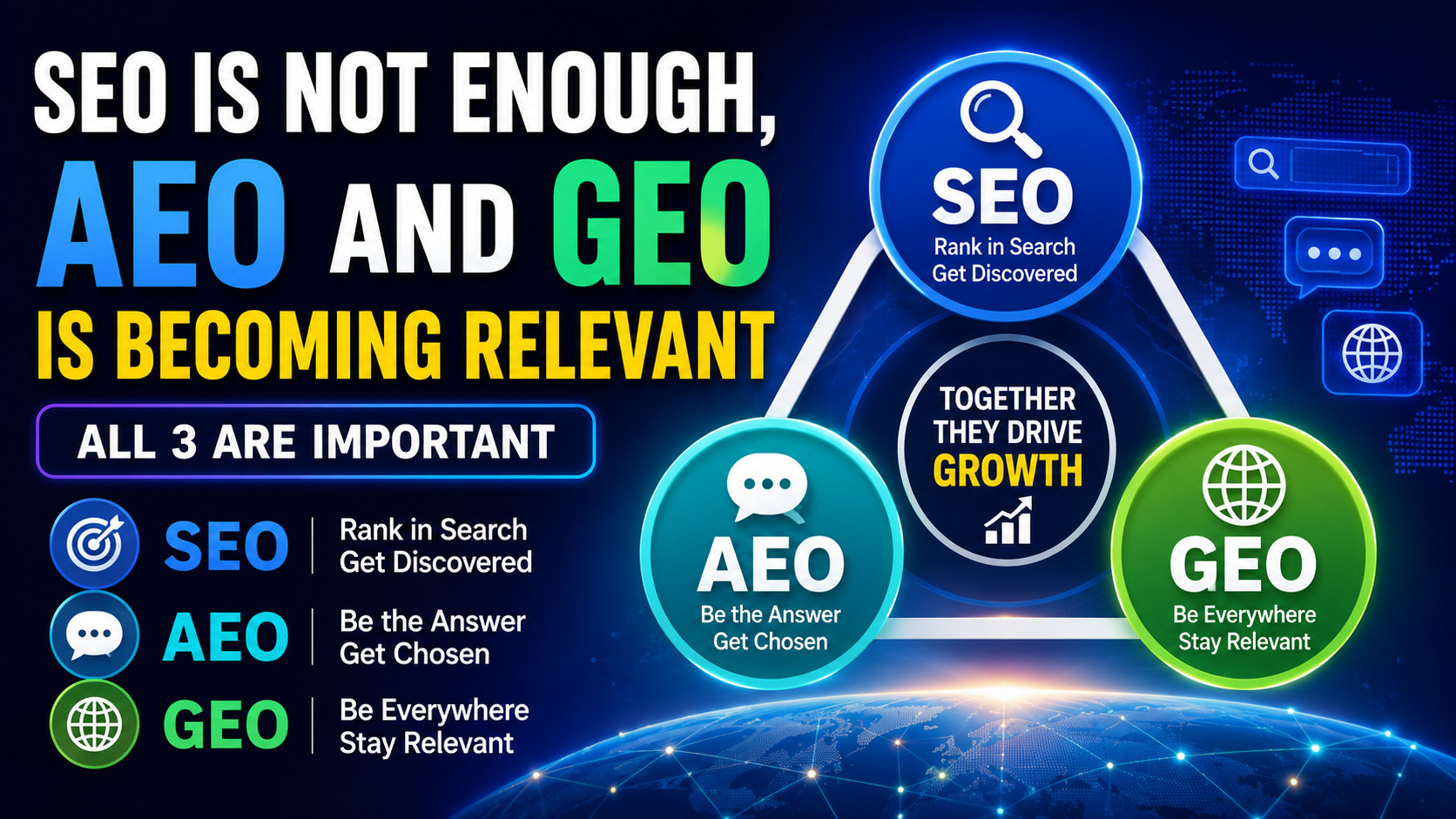
This shift has given birth to Answer Engine Optimization, or AEO, and its close cousin Generative Engine Optimization, or GEO. While traditional SEO services focus on ranking web pages in a list of blue links, answer engine optimization focuses on getting your content selected, cited, and read aloud as the direct answer to a user's question. For Indian small businesses, whether they sell products, offer web development services, or run local storefronts, understanding the SEO vs AEO difference is no longer optional. The businesses that adapt their content strategy now will own visibility in the AI search era, while those clinging to old ranking tactics alone will watch their organic traffic quietly erode.
This answer engine optimization guide explains what AEO actually is, how it differs from SEO, whether AEO is replacing SEO for Indian businesses, and exactly how a small business in India can implement an effective AEO strategy in 2026.
What Is Answer Engine Optimization and How Is It Different from SEO?
Answer engine optimization is the practice of structuring and writing content so that AI-powered search systems and answer engines can extract, understand, and present it as the definitive response to a user query. Instead of optimizing purely to rank a page, you optimize so that your specific sentences become the answer a machine reads back to a user.
The SEO vs AEO difference comes down to the end goal. Traditional SEO aims to earn a high position in a ranked list of results, betting that the user will click your link, land on your page, and convert. AEO aims to earn the answer itself, whether that answer appears in featured snippets, voice search responses, knowledge panels, or AI-generated summaries that synthesize multiple sources.
Consider the practical mechanics. A user in Pune asks, "What is the cheapest UPI payment gateway for a small business?" Under the old model, Google returned ten links and the user explored a few. Under the answer engine model, Google's AI Overview or an assistant like Gemini composes a direct paragraph answer, sometimes citing two or three sources, and the user reads it without clicking anything. This is the reality of zero-click search, and it now accounts for a majority of all searches.
This is also where GEO enters. Generative Engine Optimization specifically targets the generative AI engines, the large language model systems that compose original answers rather than just surfacing existing snippets. AEO and GEO overlap heavily in practice, both prioritize structured, authoritative, extractable content, but GEO is concerned with how your brand gets represented inside synthesized AI search results, while AEO covers the broader spectrum of answer-surfacing including voice and featured snippets. For most Indian SMBs, GEO and AEO should be pursued together as complementary halves of a single AI search visibility strategy.
The core technical and strategic distinctions:
- Optimization target: SEO optimizes pages for ranking position; AEO and GEO optimize passages for direct answer extraction and synthesis by machines and AI systems.
- Success metric: SEO measures clicks, sessions, and rankings; AEO and GEO measure citations, snippet captures, voice answer selection, and presence inside AI-generated responses.
- Content structure: SEO tolerates long, layered articles; AEO rewards clear question-and-answer formatting, concise definitions, and FAQ-style content that machines can parse without ambiguity.
Is AEO Replacing SEO for Indian Businesses in 2026?
The short answer is no, but the relationship has inverted in an important way. AEO is not replacing SEO so much as it is becoming the layer that sits on top of it. You cannot win the answer if you are not already in the eligible pool of trustworthy, well-indexed, well-structured pages, and getting into that pool is still fundamentally an SEO task. This is why most Indian agencies now bundle GEO and AEO into their core SEO services rather than selling them separately.
For Indian businesses specifically, several forces make this transition both faster and more consequential than many local marketers assume. India has one of the largest voice search user bases in the world, driven by users who prefer speaking queries in Hindi, Bengali, Tamil, and other regional languages rather than typing them. Voice search optimization in India is therefore not a niche concern, it is central to AEO, because voice assistants return exactly one spoken answer, not a list of links. If your content is not the answer, you are invisible to that user.
Google SGE in India, now operating as AI Overviews, has rolled out across a growing share of commercial and informational queries. When a prospective customer searches for "best web development services in Howrah" or "GST-compliant billing software for small shops," the AI summary that appears at the top increasingly determines which businesses get noticed. The mobile-first nature of Indian internet usage intensifies this, because on a small screen, the AI answer often fills the entire visible area before any traditional result appears.
So the future of SEO in India is not extinction. It is convergence. SEO establishes your eligibility and authority; AEO and GEO determine whether you are chosen as the answer. Businesses that treat them as a single integrated discipline will outperform those that pick one.
How Can Small Businesses in India Implement an AEO Strategy?
Implementing an AEO strategy in 2026 does not require an enterprise budget. It requires a deliberate shift in how content is researched, written, and marked up. The following is a practical implementation sequence suited to the resources of a typical Indian SMB.
Build Content Around Real Questions and FAQ Formats
Answer engines are triggered by questions. Begin by mapping the actual conversational search queries your customers ask, including the long, natural-language phrasing people use in voice search queries. Customer support logs, WhatsApp inquiries, and even sales calls are rich sources. Then structure your content so each major question is answered immediately and clearly in the first two or three sentences below a question-style heading, before you expand into detail. A dedicated FAQ section on your key service pages is one of the most reliable ways to win featured snippets and AI citations, because the FAQ format mirrors exactly how answer engines parse questions and answers.
Implement Structured Data Markup
Structured data markup, using schema.org vocabulary, is one of the highest-leverage AEO techniques because it tells machines exactly what your content means. FAQ schema, HowTo schema, Local Business schema, and Service schema all help answer engines extract and trust your information. For a business offering web development services or SEO services, marking up your service pages and FAQ blocks with structured data directly improves your chances of being surfaced for relevant AI answers.
Strengthen Entity and Local Signals
AI search results favor entities they can verify. Ensure your Google Business Profile is complete and consistent, your business name and address match everywhere across the web, and your pages clearly state who you are and what services you offer. For a business in West Bengal serving local clients, embedding contextually accurate references, the neighbourhoods you serve, the payment methods you accept such as UPI, Razorpay, and PhonePe, and rupee-denominated pricing, gives answer engines concrete, citable facts.
Write for Extraction and Synthesis
Search intent optimization in the AEO era means anticipating not just what users want, but the precise form an answer engine will need. Use clear definitions, short declarative sentences for key facts, comparison tables for "X vs Y" queries, and step-by-step lists for "how to" queries. This makes your content trivially easy for an AI system to lift and cite accurately, which is the central goal of both AEO and GEO.
What Are the Best AEO Techniques to Rank on AI-Powered Search Engines?
The strongest techniques for visibility on AI-powered search engines combine technical precision with demonstrable authority. The objective is to be the source an answer engine trusts enough to cite.
First, demonstrate genuine expertise and trustworthiness. Generative engines weight source credibility heavily when composing answers. Author bylines, citations to authoritative references, factual accuracy, and content that goes deeper than competitors all increase the probability that a system selects your content for synthesis. This is the practical face of GEO: you are optimizing not just to appear, but to be quoted.
Second, optimize for featured snippets deliberately. Featured snippets remain a primary feeder into both voice answers and AI Overviews. Identify the questions where a snippet currently appears, then format a concise, direct, factually complete answer of roughly forty to sixty words directly under a matching heading, often inside an FAQ block.
Third, maintain freshness and accuracy. Answer engines deprioritize stale or contradictory content. Regularly updating pages, correcting outdated figures, and ensuring internal consistency signals reliability to the systems deciding which sources to trust.
Fourth, cover topics comprehensively as clusters rather than isolated posts. When your site demonstrates depth across an entire subject area, with interlinked supporting content and service pages, answer engines recognize topical authority and are more likely to draw answers from your domain across many related queries.
Fifth, address conversational and regional-language search intent. Because so much Indian voice search happens in regional languages and natural phrasing, content that answers questions the way real people actually ask them, rather than in stiff keyword phrases, captures a segment competitors routinely ignore.
Do I Need Both AEO and SEO for My Business Website in India?
Yes. For any Indian business website in 2026, the correct posture is to run AEO, GEO, and SEO as one integrated programme rather than choosing between them. They solve different problems at different stages of the same visibility funnel.
SEO does the foundational work. It ensures your site is crawlable, fast, mobile-friendly for tier-2 and tier-3 network conditions, properly indexed, and authoritative enough to be considered a credible source. Without this foundation, no amount of answer formatting will get you cited, because you will not be in the candidate set that answer engines draw from in the first place.
AEO and GEO do the capture work. Once your site is eligible, they determine whether your content becomes the featured snippet, the voice answer, or the cited source inside an AI summary. In a zero-click search environment, this is increasingly where actual visibility, and brand recall, is won, even when the click never happens.
The practical implication for resource allocation is that an Indian SMB should not abandon proven SEO fundamentals. Instead, retain SEO as the base layer and progressively layer AEO and GEO practices, question-led FAQ structure, structured data markup, entity consistency, and extraction-friendly writing, on top of existing content. The cost of adding these to existing SEO services is modest; the cost of ignoring them as AI search results consume more of the result page is steadily rising visibility loss.