
Overview
There is a particular kind of financial blindness that affects Indian small business owners more than most. It manifests as a willingness to spend ₹1.5 to ₹2 lakh on a website that generates zero inbound enquiries, while simultaneously ignoring a free tool that puts the business directly in front of customers at the exact moment they are searching for it. That tool is the Google Business Profile, and if you are a local business owner in India who has not optimized it — or worse, has not even claimed it — you are hemorrhaging revenue you never knew existed.
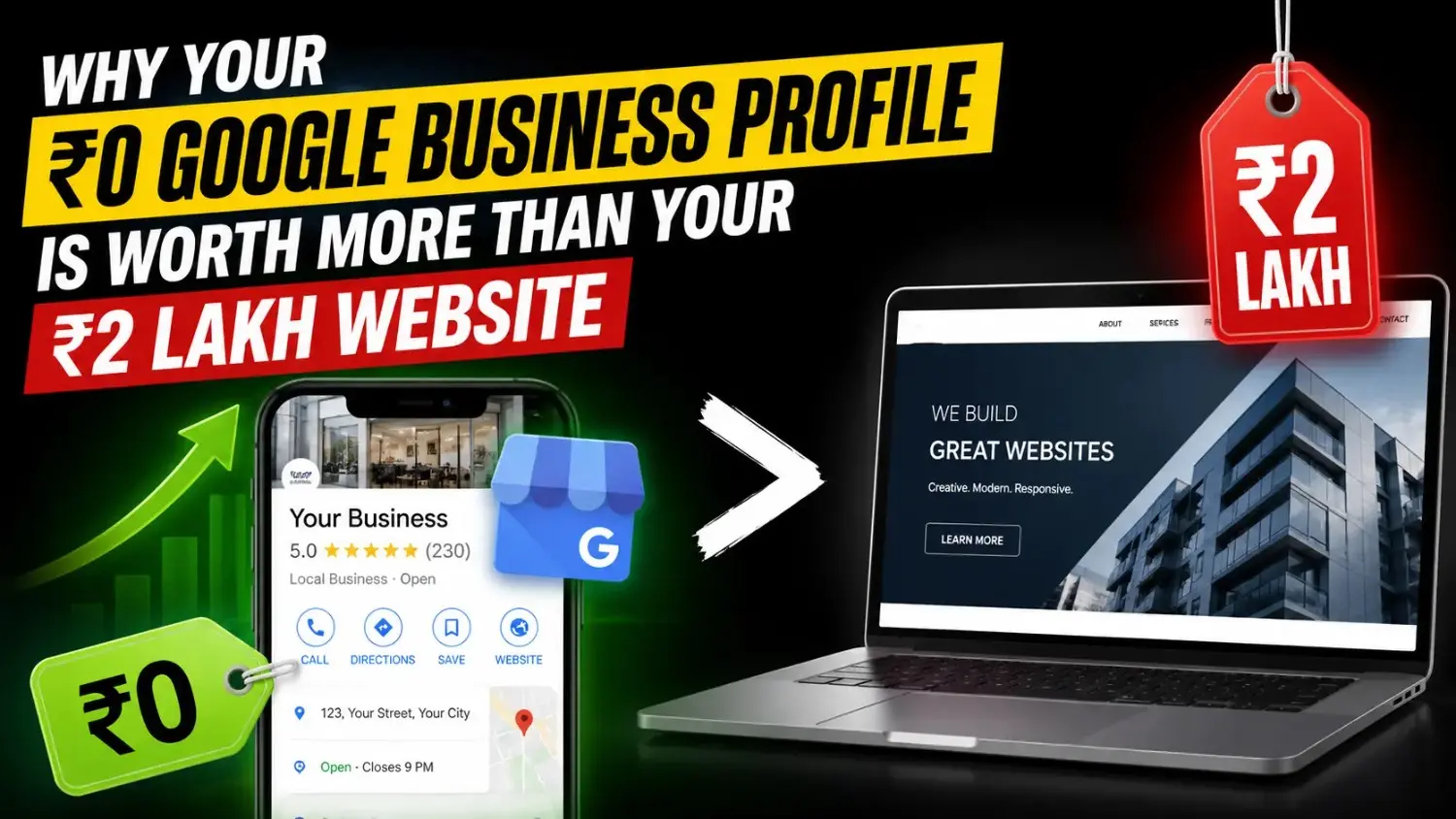
This is not another lecture on why Google matters. Every digital marketing blog in India recycles that line. This is a specific, uncomfortable argument: that the ₹0 Google Business Profile sitting unclaimed or half-filled in your name is generating more potential customer touchpoints than the expensive website you proudly show off at networking events. The difference is, one of these assets is working. The other is a digital brochure that nobody reads.
The average Indian SMB owner in a tier-2 or tier-3 city treats website creation as the defining moment of going digital. Agencies encourage this because building websites pays their bills. But nobody explains that a Google Business Profile — fully optimised, regularly updated, and actively managed — often outperforms that website in local search visibility by a factor that should embarrass the entire web development industry.
The ₹2 Lakh Website Delusion That Indian SMBs Refuse to Examine
Let us be specific about what ₹1.5 to ₹2 lakh typically buys in the Indian market. It buys a five to eight page website built on WordPress or custom PHP. It includes a homepage with a slider nobody interacts with, an about page, a service page, a portfolio page, a contact form, and perhaps a blog section that has not been updated since the site launched. The hosting runs on an Indian provider at ₹3,000 to ₹5,000 per year. The domain costs ₹800 annually. And the entire structure sits unindexed or poorly indexed because nobody invested in ongoing SEO service after the initial build.
Here is the part that stings. That website, in isolation, does not rank for local search queries. When someone in Howrah types "best AC repair near me" or "chartered accountant in Salt Lake," Google does not surface your website in the local pack. It surfaces your Google Business Profile — or, more accurately, it surfaces the Google Business Profile of your competitor who bothered to fill theirs out properly.
The local pack — those three business listings that appear with a map at the top of Google search results — captures roughly 42 percent of all clicks on local search queries. Your website, even if it ranks on page one organically, sits below that local pack. The customer has already called your competitor before they scroll down to your beautifully designed homepage.
This is not an argument against websites. A well-built site remains an essential component of digital infrastructure. But it is an argument against the sequencing error that most Indian business owners make: spending the bulk of their digital budget on a website while treating the Google Business Profile as an afterthought checkbox during setup.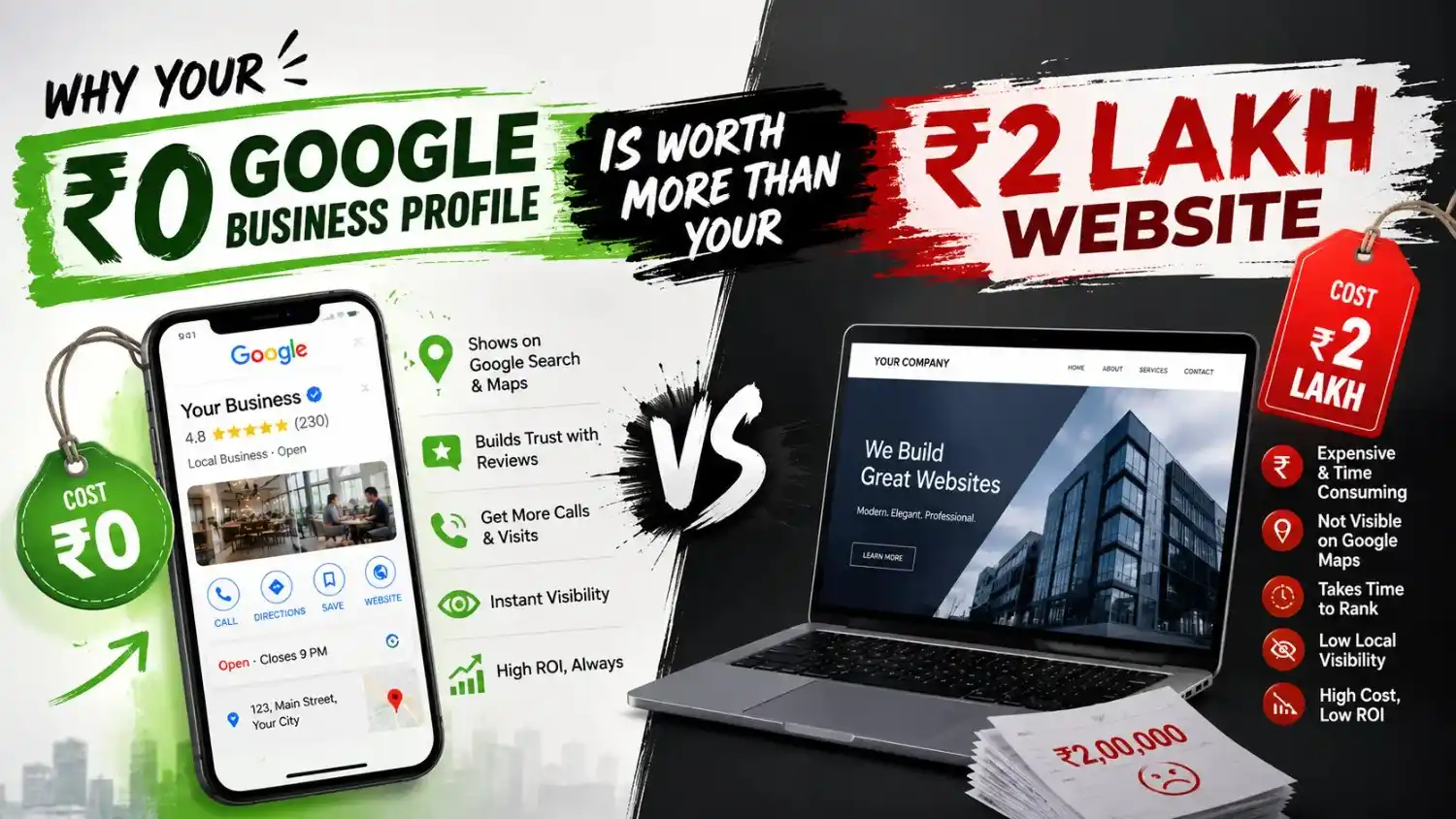
What a Google Business Profile Actually Does That Your Website Cannot
Direct Placement in the Local Search Ecosystems
When a potential customer searches for a service in their area, Google uses a different algorithm for the local pack than it does for organic search results. This local algorithm weighs three factors disproportionately: relevance, distance, and prominence. Your website affects prominence indirectly through backlinks and domain authority. But your Google Business Profile affects all three factors directly.
Your Google business listing communicates to Google exactly what services you offer (relevance), where you are physically located (distance), and how customers perceive you through reviews and engagement (prominence). No website, regardless of how much you spent on it, can transmit this information to Google's local algorithm as directly or as efficiently.
When you create a Google Business Profile, you are not merely listing your business. You are plugging directly into Google's local search infrastructure. Every photo you upload, every review you respond to, every Google Post you publish, and every Q&A you answer feeds the algorithm additional signals that a static website fundamentally cannot replicate.
Trust Signals That No Amount of Web Design Can Manufacture
Consider the psychology of a customer in Kolkata searching for "plumber near me" at 10 PM on a weekday. They see three results in the local pack. One has 147 reviews with a 4.6 rating, business hours showing "Open now," photos of completed work, and a direct call button. Another has 12 reviews and no photos. The third is a website link buried in organic results.
The customer calls the first business. They do not visit anyone's website. They do not read anyone's about page. They do not browse anyone's portfolio section. The decision was made entirely within the Google Business Profile ecosystem.
This pattern repeats millions of times daily across Indian cities. The trust signals that matter to a customer making an urgent or semi-urgent local purchasing decision — reviews, ratings, hours, photos, proximity — all live on the Google business listing. Your website, with its carefully worded service descriptions and animated hero sections, is irrelevant at the point of decision.
Why Indian Businesses in Tier-2 and Tier-3 Cities Lose Disproportionately
The neglect of Google Business Profile optimisation hits Indian SMBs harder than their counterparts in mature digital markets, for a structural reason that nobody discusses. In cities like Howrah, Ranchi, Bhubaneswar, Jaipur, or Lucknow, the competitive density on Google Business Profile is still remarkably low. Most local businesses have either not claimed their listing, or have claimed it and abandoned it after entering a phone number and address.
This means the barrier to local pack dominance in these cities is absurdly low. A business owner who takes thirty minutes per week to post updates, respond to reviews, upload fresh photos, and answer questions on their Google Business Profile will outrank competitors who spent lakhs on web development service contracts but never touched their GBP.
In metro cities like Mumbai, Delhi, or Bangalore, GBP competition is intensifying. But even there, the optimisation gap is significant. Most businesses stop after verification. They do not use Google Posts. They do not track insights through the Google Business Profile dashboard. They do not add attributes, update seasonal hours, or leverage the product and service catalogue features.
For a country where mobile-first search behaviour dominates and where UPI-enabled purchases can happen within minutes of discovery, the Google Business Profile is not a "nice to have." It is the storefront. The fact that it costs nothing to create a business profile on Google makes the neglect even more indefensible.
The Google Business Profile Dashboard — A Free Analytics Tool You Are Ignoring
When you log into your Google my business account and access the Google Business Profile dashboard, you gain access to data that most Indian business owners do not realise exists. The dashboard shows you how many people viewed your listing, how many requested directions, how many called you directly from the listing, and which search queries triggered your profile to appear.
This data is not decorative. It tells you, in precise terms, what your customers are searching for when they find you. If you run an electrical repair shop in Durgapur and the dashboard shows that 40 percent of your profile views come from the query "electrician for home wiring near me," that is keyword intelligence you can use across your entire digital presence — including your website, your blog content strategy, and your paid advertising.
Most businesses pay ₹10,000 to ₹25,000 per month for SEO tools that deliver similar keyword data. The Google Business Profile dashboard provides a version of this for free, specific to your actual customer base, and most business owners in India have never opened it.
The dashboard also tracks photo views, which provides a direct feedback loop on visual content engagement. If you uploaded ten photos of your shop interior and the dashboard shows that photos of completed projects get five times more views, that tells you exactly what visual content to produce more of. This is actionable business intelligence at zero cost.
How to Create a Google Business Profile That Actually Performs
The process to create a Google Business Profile is technically simple but strategically layered. Most guides online walk you through the mechanical steps — go to business.google.com, enter your business name, select a category, verify by postcard or phone. That is the easy part. What separates a high-performing listing from the thousands of abandoned ones in Indian cities is what happens after verification.
NAP Consistency as the Non-Negotiable Foundation
NAP — Name, Address, Phone number — must be identical across every online mention of your business. If your Google business listing says "Raj Enterprises, 14/2 GT Road, Howrah" but your website says "Raj Enterprises, 14/2, G.T. Road, Howrah - 711101," Google sees inconsistency. This damages your local ranking. The fix is tedious but essential: audit every directory listing, social media profile, and website footer to ensure exact character-level NAP consistency.
Category Selection and Attribute Optimization
Google allows you to select a primary business category and multiple secondary categories when you create a business profile on Google. The primary category has the strongest influence on which searches trigger your listing. Many Indian businesses select overly broad categories like "Business Service" when a specific category like "Web Development Company" or "Tax Consultant" would deliver far more relevant traffic.
Attributes — such as "Women-led," "Wheelchair accessible," "Free Wi-Fi," or "Accepts UPI payments" — are additional signals that most Indian businesses leave blank. Every unfilled attribute is a missed ranking signal and a missed trust signal for the customer.
The Review Engine That Compounds Over Time
Reviews on your Google my business account are not just social proof. They are a direct ranking factor. Businesses with more reviews, higher average ratings, and — critically — recent reviews rank higher in the local pack than businesses with stale or sparse review profiles.
The mistake most Indian business owners make is treating reviews passively. They wait for customers to leave reviews organically. A deliberate review acquisition strategy — asking satisfied customers at the point of service completion, sending a WhatsApp message with a direct review link, training front-desk staff to request reviews — compounds over months into a moat that competitors cannot easily replicate.
Responding to every review, positive or negative, signals to Google that the business is active and engaged. A business that responds to reviews ranks higher than an identical business that does not. This is documented in Google's own local search ranking documentation.
The Real Comparison — Google Business Profile Versus Your Website
This is not an either-or proposition, and framing it that way would be intellectually dishonest. A website provides long-form content depth, conversion-optimized landing pages, blog infrastructure for topical authority, and a controlled brand environment. What a website does not provide, in isolation, is local search dominance.
The Google Business Profile provides local pack visibility, direct customer engagement through reviews and Q&A, zero-click conversions through call buttons and direction requests, and algorithm-feeding signals through regular activity. What it does not provide is long-form content depth or complex conversion funnels.
The intelligent approach — and the one that businesses serious about digital growth in India should adopt — is treating the Google Business Profile as the primary local acquisition channel and the website as the depth and conversion layer that supports it. This inverts the typical Indian SMB priority hierarchy, where the website gets all the budget and the GBP gets none.
Agencies that offer genuine seo service will tell you this. The ones that only sell website packages will not.
What Infinite Option Recommends for Indian SMBs
At Infinite Option, the position we take with clients is straightforward. If you have not fully optimised your Google Business Profile, spending money on a new website is premature. We work with businesses across Howrah, Kolkata, and West Bengal to build digital presences that start with GBP optimisation and layer website, content, and paid acquisition on top of that foundation.
Our blog covers these topics in depth because we believe Indian small business owners deserve transparent guidance, not upselling. If your Google my business account is unverified, half-complete, or collecting digital dust while you pour money into a website that nobody finds through local search, the priority correction is clear and it costs you nothing but time.
Conclusion
The provocative framing of this article — that a free tool is worth more than a ₹2 lakh website — is not hyperbole for the majority of local Indian businesses. It is a measurable, observable reality in search data. The Google Business Profile captures customer intent at the moment it is highest, delivers it to businesses at zero cost, and rewards consistent effort with compounding local visibility.
Your website matters. But if you had to choose where to spend your next thirty minutes of digital effort, the answer is not your homepage slider. It is your Google Business Profile. Claim it, complete it, optimise it, and maintain it. The returns will make your website investment look like a rounding error.