
Overview
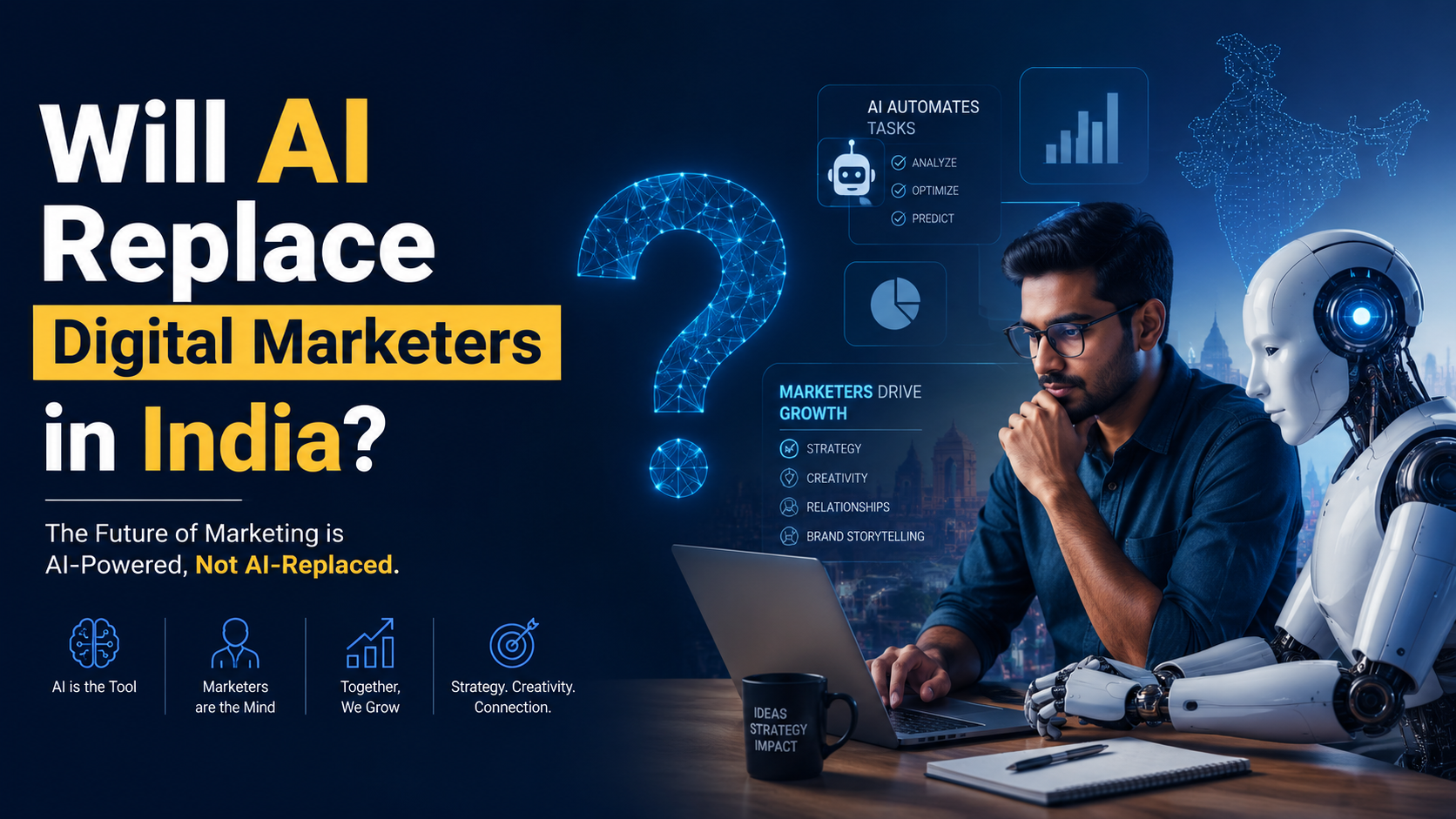
Every other week, a new LinkedIn post goes viral claiming that digital marketers are finished. That AI tools will handle everything from Google Ads to Instagram reels by next quarter. That anyone still offering digital marketing services manually is a dinosaur waiting for the meteor. And every time, the comments section splits into two predictable camps — doomsayers quoting ChatGPT outputs, and defensive professionals insisting nothing will change. Both are wrong. The reality for digital marketers in India is far more nuanced, far more interesting, and far more consequential than either camp admits. This post unpacks what AI actually threatens, what it cannot touch, and what Indian digital marketing professionals need to do right now to stay relevant — or get left behind.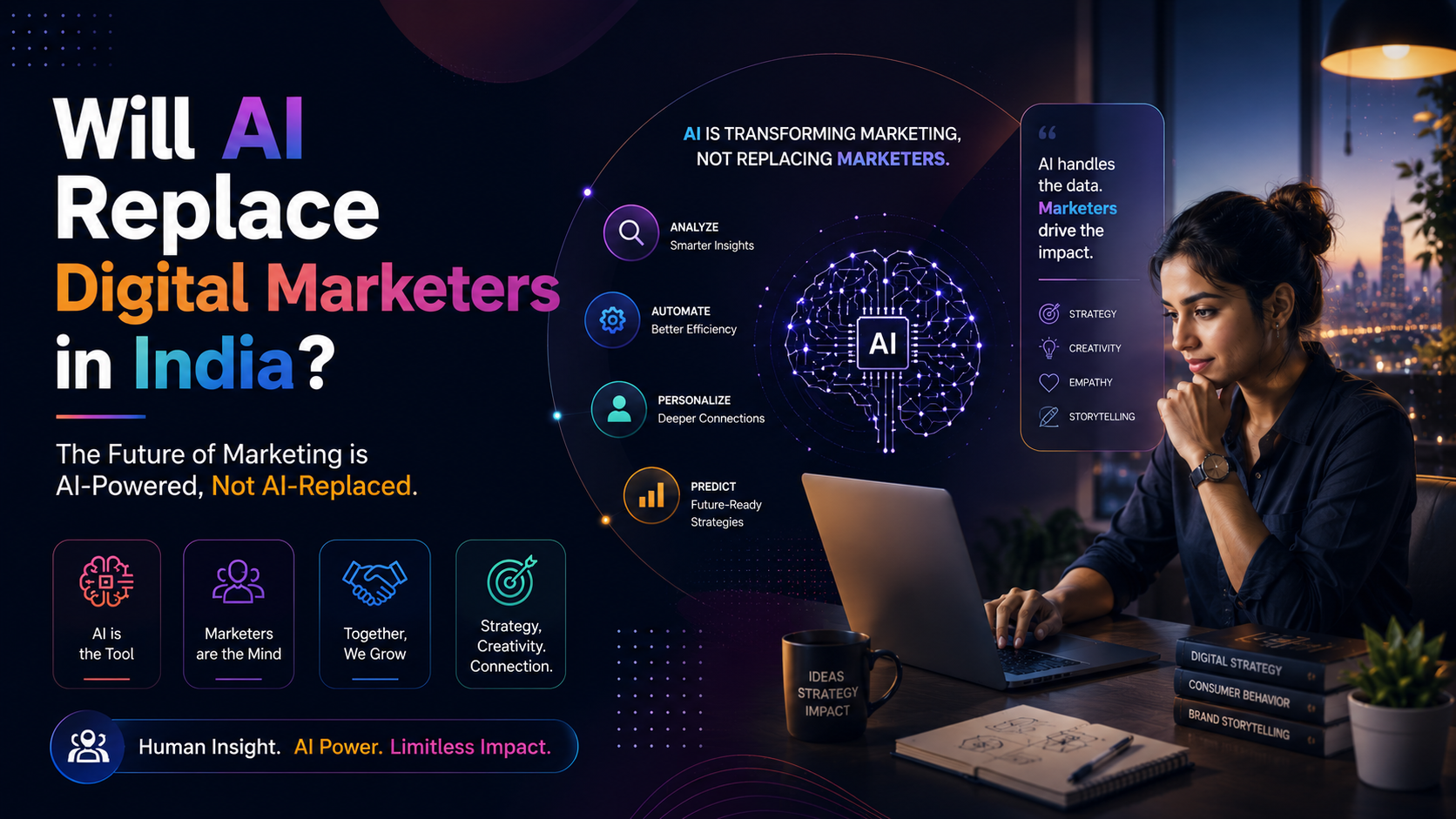
The AI Panic Is Real, But the Data Tells a Different Story
If you spend enough time on marketing Twitter or Indian startup WhatsApp groups, you would think every digital marketing agency in the country is weeks away from shutting down. The narrative is seductive — tools like ChatGPT, Jasper, Copy.ai, and Gemini can generate ad copy, write blog posts, create social media calendars, and even build rudimentary landing pages. Why would anyone pay a digital marketing company when a Rs 1,600/month subscription does the same thing?
Here is the problem with that argument. India's digital advertising market crossed Rs 36,000 crore in 2024 and is projected to grow at over 25% CAGR through 2028. The number of registered digital marketing agencies in India has actually increased year over year since ChatGPT launched in late 2022. Every major digital marketing company in the country — from boutique shops to full-service firms — reported growth in 2024-25, not contraction. Hiring for mid-level and senior digital marketers has not collapsed — it has shifted. Platforms like Naukri and LinkedIn show consistent demand for professionals who can do what AI cannot: strategise, contextualise, negotiate, and build relationships with clients who still prefer a phone call over a chatbot.
The panic is understandable. But the data does not support mass extinction. It supports evolution.
What AI Actually Does Well in Digital Marketing
To have an honest conversation about whether AI will replace digital marketers, you need to first acknowledge where AI genuinely outperforms humans. Pretending AI is useless is just as dangerous as pretending it is omnipotent.
Automation of Repetitive Execution
AI tools excel at tasks that are high-volume, rule-based, and repetitive. Scheduling social media posts across platforms. Generating A/B test variations for email subject lines. Pulling weekly analytics reports and formatting them into dashboards. Automating bid adjustments in PPC campaigns. These are tasks that consumed 30-40% of a digital marketer's workday five years ago. Today, tools like Meta's Advantage+ campaigns, Google's Performance Max, and platforms like HubSpot and SEMrush have automated significant chunks of this grunt work.
Any digital marketing company still billing clients primarily for these execution-level tasks is, frankly, on borrowed time. Not because AI is brilliant — but because automation has made these tasks commodities. If someone asks you to explain digital marketing value in 2026, you cannot justify premium retainers for work a Rs 1,600 subscription handles.
Data Processing and Pattern Recognition
Where AI genuinely shines is in crunching datasets that would take a human team weeks. Identifying audience micro-segments from CRM data. Detecting anomalies in campaign performance before they become budget leaks. Predicting which creative variants will outperform based on historical engagement data. A digital marketing agency that uses AI for these analytical functions gains a meaningful competitive advantage. A digital marketing company that ignores them loses efficiency — and eventually, clients. The gap between AI-augmented digital marketing services and fully manual operations widens every quarter.
What AI Cannot Do — And Why Indian Markets Make It Harder
Here is where the "AI replaces everything" narrative collapses, especially in the Indian context.
Cultural Context and Regional Nuance
Try asking ChatGPT to write a Diwali campaign for a saree brand targeting tier-2 women in Tamil Nadu. What you get will be grammatically correct, culturally generic, and commercially useless. Indian digital marketing services require understanding that a Pongal campaign in Coimbatore is fundamentally different from a Makar Sankranti campaign in Pune — even though both involve harvest festivals. The linguistic diversity, regional sentiment, festival calendars, and local purchasing behaviour across India's 28 states create a complexity layer that no large language model currently handles well. No digital marketing company can outsource this contextual intelligence to a chatbot.
Digital marketers in India who understand the difference between what works in Jaipur versus what works in Kochi hold an advantage that cannot be replicated by prompt engineering. When a local business owner in Howrah wants to run ads targeting customers within a 10 km radius, they need someone who understands the local buying cycle tied to GST filing dates, wedding seasons, and even IPL match schedules — not an AI model trained predominantly on Western consumer data.
Client Relationships and Trust Building
India's SMB market runs on trust and relationships. A business owner in Indore is not going to hand over their Rs 50,000/month ad budget to a chatbot. They want to speak to a person. They want WhatsApp updates. They want to know that when something goes wrong with their Google Ads account at 11 PM, someone will pick up the phone. This is not a limitation that AI will "solve" with better UX. It is a structural feature of how Indian small businesses operate. Every serious digital marketing agency in India knows that client retention is built on chai meetings, festival greetings, and showing up when things break — not on dashboards.
The Digital Marketer Salary Question Nobody Wants to Discuss Honestly
If AI were truly replacing digital marketers, you would expect salaries to crater. The opposite is happening, with a caveat. Entry-level salaries for digital marketers in India doing purely execution work — posting on social media, basic reporting, manual email blasts — have stagnated or declined in real terms. These are the roles most vulnerable to AI automation. But salaries for digital marketers with strategic, analytical, or client management capabilities have actually increased. A mid-level performance marketing manager in Bangalore or Mumbai now commands Rs 8-14 LPA. A senior SEO strategist with proven results can push past Rs 18-20 LPA.
What is happening to the digital marketer salary curve is not compression — it is bifurcation. The floor is dropping for commodity skills. The ceiling is rising for strategic skills. The same bifurcation applies at the organisational level — a digital marketing agency paying low salaries for pure execution work faces high attrition, while firms investing in AI-skilled strategists retain talent. If you want to explain digital marketing career prospects to someone entering the field today, this is the most important distinction to communicate: your value is directly proportional to how hard your skill set is to automate. The digital marketer salary you command in 2028 will be a direct reflection of whether you chose the automation-proof side of this divide.
Why Indian Digital Marketing Agencies Are Hiring More, Not Less
This seems counterintuitive. If AI handles execution, why would a digital marketing company need more people? Because the scope of what clients expect from digital marketing services has expanded dramatically. And paradoxically, this expansion means the average digital marketing agency now requires more specialised human talent, not less.
Five years ago, an Indian SMB might hire a digital marketing agency to "handle Facebook." Today, that same client expects an integrated strategy spanning Google Ads, Meta campaigns (with separate strategies for Facebook, Instagram, and WhatsApp Business), YouTube Shorts, local SEO with optimised Google Business Profile, reputation management, influencer coordination, and increasingly, visibility on AI-powered search platforms like ChatGPT and Gemini. The surface area of digital marketing has multiplied. AI handles individual tasks faster — but the orchestration, strategy, and cross-platform integration still require human professionals.
Agencies in India that have adopted AI tools report that their headcount has not decreased. Instead, the role composition has shifted. Fewer junior executors, more mid-level strategists and client managers. The overall team size often stays the same or grows because the service offering has expanded.
The Real Threat Is Not AI — It Is Digital Marketers Who Ignore AI
Here is the uncomfortable truth that neither the doomsayers nor the optimists want to hear. AI will not replace digital marketers. But digital marketers who use AI will absolutely replace those who refuse to. The threat is not the technology itself — it is the competitive gap between professionals who integrate AI into their workflow and those who treat it as a novelty or a threat.
A digital marketing agency in 2026 that still manually writes every ad copy variant, manually pulls every analytics report, and manually researches every keyword is not "artisanal" — it is inefficient. Clients notice. When one digital marketing company delivers a comprehensive competitor analysis in two days using AI-assisted tools, and another takes two weeks doing it manually, the market makes its choice. The client does not care whether you can explain digital marketing theory — they care about speed, accuracy, and results. And AI-integrated digital marketing services deliver all three faster.
This applies equally to freelancers and in-house teams. If you are a digital marketer in India and you have not integrated tools like ChatGPT, Gemini, Perplexity, Surfer SEO, or Jasper into at least some part of your workflow, you are already behind.
How to Explain Digital Marketing in the AI Era
The way we explain digital marketing itself needs to evolve. The old definition — "promoting products or services through digital channels" — is technically correct but increasingly incomplete. In 2026, digital marketing also means ensuring your brand is the answer when someone asks ChatGPT a question. It means optimising for AI-generated search results through Generative Engine Optimisation. It means understanding that the customer journey now includes AI intermediaries between the searcher and your website.
When you explain digital marketing to a client or a newcomer today, the explanation must include this AI layer. It is no longer just SEO, PPC, social media, and email. It is SEO plus AEO. It is paid ads plus AI-generated ad variations. It is content marketing plus AI content auditing. Any digital marketing company that cannot explain digital marketing in these expanded terms risks sounding outdated to increasingly AI-literate clients. The professionals and agencies who can articulate this expanded reality will win the trust — and the budgets.
What Digital Marketing Services Actually Look Like in 2026
The service catalogue of a competitive digital marketing company in India today looks significantly different from even two years ago. Traditional digital marketing services — SEO, social media management, PPC, content marketing, email campaigns — remain the foundation. But the additions are where a digital marketing agency differentiates itself from the pack.
Forward-thinking agencies now offer AI search visibility audits — checking whether a brand appears when users query tools like ChatGPT, Perplexity, or Gemini. They offer AI-assisted content production where human strategists set direction and AI generates first drafts that are then refined. They offer predictive analytics using AI models trained on client-specific historical data. They offer automated reporting dashboards that free up account managers to focus on strategy instead of spreadsheets. Agencies like Infinite Option, for instance, are already integrating AI-powered content workflows and GEO strategies alongside conventional digital marketing services for Indian SMBs.
The agencies that will struggle are those still selling 2019-era service packages at 2019-era prices without any AI augmentation.
The Verdict — Replacement Versus Restructuring
Will AI replace digital marketers in India? No. But AI is already restructuring what it means to be a digital marketer. The professionals who survive — and thrive — will be those who treat AI as infrastructure rather than competition. They will use AI to handle the commodity layer of execution while they focus on strategy, cultural context, client relationships, and the kind of creative judgment that no model can replicate.
The question was never really "will AI replace digital marketers?" The real question is: "which digital marketers will adapt fast enough?" In India, where the market is growing, the complexity is unmatched, and client relationships still run on trust and regional fluency, the answer favours humans — but only the ones willing to evolve.
If your business is looking for digital marketing services that combine AI-powered efficiency with the strategic depth and cultural understanding that Indian markets demand, Infinite Option builds exactly that — a digital marketing agency blending modern AI workflows with human expertise rooted in how Indian businesses actually operate.